Urban Air Quality Tracking Services Guide: Monitoring Methods and Technology
Urban air quality tracking refers to the continuous measurement, analysis, and reporting of pollution levels in cities and densely populated areas. It helps communities, environmental researchers, urban planners, and government authorities understand the condition of the air people breathe. As cities expand and transportation, construction, manufacturing, and energy consumption increase, monitoring atmospheric pollution has become an important part of environmental management.
Air pollution contains different substances, including particulate matter, nitrogen dioxide, sulfur dioxide, carbon monoxide, ground-level ozone, and volatile organic compounds. These pollutants can originate from road traffic, industrial facilities, power generation, construction activities, household energy use, and natural events such as wildfires.
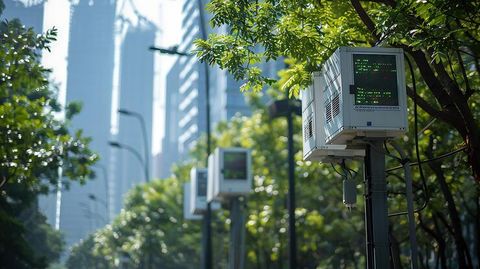
Urban air quality tracking systems collect information from monitoring stations, portable sensors, satellite observations, and other environmental technologies. The collected information is processed into reports, maps, measurements, and Air Quality Index (AQI) readings.
These systems help identify pollution patterns across different neighbourhoods and time periods. Instead of relying only on occasional environmental inspections, cities can use continuous measurements to understand changing conditions and develop more informed environmental policies.
What Does Urban Air Quality Monitoring Measure?
Common measurements include:
PM2.5: Fine particulate matter with a diameter of 2.5 micrometres or smaller.
PM10: Particles measuring 10 micrometres or smaller.
Nitrogen dioxide (NO2): A pollutant commonly associated with vehicle engines and combustion.
Sulfur dioxide (SO2): A gas often released through industrial activities and fuel combustion.
Carbon monoxide (CO): A colourless gas produced by incomplete combustion.
Ground-level ozone (O3): A pollutant formed through chemical reactions involving sunlight and other emissions.
How Urban Air Quality Tracking Systems Work
A typical air quality monitoring network follows several steps:
Data collection: Monitoring stations and environmental sensors measure pollutant concentrations.
Data transmission: Measurements are transferred to central databases through wireless networks or wired connections.
Data analysis: Environmental monitoring software processes readings and identifies pollution patterns.
AQI calculation: Measurements are converted into an Air Quality Index using the relevant national calculation method.
Public reporting: Results are presented through dashboards, mobile applications, alerts, and environmental reports.
Monitoring systems can operate continuously or collect measurements at scheduled intervals. Their accuracy depends on sensor calibration, installation location, maintenance, and environmental conditions.
Why Urban Air Quality Tracking Matters
Air pollution is a major environmental concern because it affects public health, urban development, transportation planning, and environmental sustainability. Population growth and expanding economic activity can increase emissions, making accurate pollution information increasingly important.
Urban air quality monitoring helps authorities understand where pollution occurs, when concentrations increase, and which activities may contribute to the problem.
Public Health and Environmental Awareness
Air pollution can affect respiratory and cardiovascular health. Fine particulate matter is particularly important because small particles can penetrate deep into the respiratory system.
Air quality information helps individuals and communities understand environmental conditions and make informed decisions about outdoor activities.
Important applications include:
Identifying periods of elevated particulate matter.
Understanding pollution differences between neighbourhoods.
Supporting public health communication.
Providing information during wildfire smoke or dust events.
Identifying areas that require additional environmental investigation.
Supporting Smart City Planning
Smart city environmental monitoring combines air quality sensors, geographic information systems, weather information, and connected infrastructure.
Urban planners can use this information to understand how pollution relates to road networks, industrial zones, residential developments, and green spaces.
For example, monitoring data may reveal higher nitrogen dioxide concentrations near busy roads. Planners can use these findings when evaluating traffic management, public transportation improvements, and urban development proposals.
Industrial Emissions and Environmental Compliance
Industrial facilities can release particulate matter, gases, and other atmospheric pollutants. Environmental monitoring equipment helps authorities and facility operators understand emission patterns and evaluate compliance with applicable environmental requirements.
Industrial emissions monitoring and ambient air quality monitoring are related but different activities.
Industrial emissions monitoring measures pollutants released from specific sources, such as factory exhaust stacks.
Ambient air monitoring measures pollution present in the surrounding outdoor environment.
Source apportionment studies investigate the contribution of different pollution sources to measured concentrations.
Combining these approaches provides a more complete understanding of urban pollution.
Economic and Infrastructure Planning
Poor air quality can affect transportation, construction activities, tourism, and general urban productivity. Environmental data helps governments consider pollution levels when planning infrastructure and allocating resources.
It also supports environmental impact assessments and long-term sustainability strategies.
Common Air Quality Monitoring Technologies
Technology | Main purpose | Typical application |
|---|---|---|
Reference monitoring stations | High-quality pollutant measurement | Regulatory monitoring |
Low-cost air quality sensors | Local pollution observations | Neighbourhood monitoring |
Satellite observations | Large-area atmospheric assessment | Regional pollution analysis |
Mobile monitoring units | Measurements across multiple locations | Road and urban studies |
Weather monitoring equipment | Wind, humidity, and temperature readings | Pollution forecasting |
Environmental monitoring software | Data processing and reporting | Smart city dashboards |
Recent Developments in Urban Air Quality Tracking
Urban air quality tracking has developed through improvements in sensor technology, data processing, satellite observations, and environmental regulations. During 2025 and 2026, several developments highlighted the growing importance of accurate monitoring networks and accessible environmental information.
Expansion of Air Quality Monitoring Networks
In February 2026, India's Ministry of Environment, Forest and Climate Change reported plans to strengthen continuous ambient air quality monitoring across Delhi and the National Capital Region.
The initiative included the addition of 27 monitoring stations, alongside an existing network of 84 stations. The expansion considered population distribution, industrial areas, residential locations, traffic patterns, and regional pollution movement.
This approach demonstrates why monitoring networks need adequate geographical coverage rather than concentrating only on city centres.
Greater Attention to Monitoring Accuracy
Environmental authorities are increasingly focusing on measurement quality, equipment calibration, and reliable data collection.
In May 2025, the European Union published technical guidance supporting the implementation of its revised air quality legislation. The guidance addressed reference and non-reference measurement methods, quality assurance, and data reliability.
These developments are important because low-cost sensors can provide useful local information, but their readings may differ from measurements produced by regulatory-grade instruments.
Growth of Data-Driven Environmental Management
Air quality monitoring increasingly combines multiple information sources, including:
Internet of Things (IoT) environmental sensors.
Geographic Information Systems (GIS).
Artificial intelligence-based data analysis.
Satellite-based atmospheric observations.
Weather forecasting systems.
Cloud-based environmental data platforms.
These technologies help researchers identify pollution hotspots, examine seasonal variations, and develop pollution forecasting models.
However, forecasts are estimates rather than guaranteed predictions. Their reliability depends on the quality of input data, modelling methods, and local atmospheric conditions.
Progress in India's Clean Air Programme
India's National Clean Air Programme (NCAP) continued to support city-level pollution reduction and monitoring activities during 2025–2026.
A September 2026 government update reported that 108 cities recorded lower PM10 levels in financial year 2025–26 compared with the 2017–18 baseline. The programme covers 130 cities and combines monitoring, urban planning, and pollution control measures.
These developments demonstrate how environmental monitoring can support the evaluation of long-term pollution reduction efforts.
Laws, Policies, and Government Regulations
Urban air quality tracking is influenced by environmental protection laws, national air quality standards, monitoring requirements, and international guidelines. Although regulations differ between countries, their common purpose is to measure pollution, protect public health, and encourage improvements in environmental conditions.
World Health Organization Guidelines
The World Health Organization (WHO) publishes global air quality guidelines covering pollutants such as PM2.5, PM10, nitrogen dioxide, sulfur dioxide, ozone, and carbon monoxide.
These guidelines provide scientific recommendations that governments can consider when developing national air quality standards.
They are not automatically legally binding in every country. Individual governments establish their own regulatory limits and monitoring requirements.
European Union Air Quality Regulations
The European Union introduced the revised Ambient Air Quality Directive (EU) 2024/2881, which entered into force on 10 December 2024.
The directive strengthens air quality assessment, monitoring, public information, and pollution reduction requirements. It also brings EU air quality standards closer to WHO recommendations, with stricter limits planned for 2030.
Its main provisions include:
Improved monitoring networks and measurement methods.
Updated standards for major air pollutants.
Better access to environmental information.
Stronger air quality planning requirements.
Regular reviews based on scientific evidence.
EU member states must implement the directive through their national frameworks.
United States Environmental Regulations
In the United States, the Environmental Protection Agency (EPA) administers the Clean Air Act, which provides the national framework for controlling air pollution.
The EPA establishes National Ambient Air Quality Standards (NAAQS) for certain pollutants. State and local environmental agencies operate monitoring networks to measure outdoor air pollution and assess compliance.
Reference monitoring equipment must follow technical and quality assurance requirements. Lower-cost sensors can supplement monitoring networks, but their readings are not automatically accepted for official regulatory compliance determinations.
India's Air Pollution Control Framework
India regulates air pollution through several national laws and programmes.
Important examples include:
Air (Prevention and Control of Pollution) Act, 1981: Establishes the legal framework for preventing and controlling air pollution.
Environment (Protection) Act, 1986: Provides broader powers for environmental protection.
National Clean Air Programme: Supports city-specific pollution reduction strategies.
National Ambient Air Quality Standards: Establishes permissible concentration limits for specified pollutants.
Commission for Air Quality Management Act, 2021: Establishes a dedicated framework for coordinated air pollution management in Delhi-NCR and adjoining areas.
The Central Pollution Control Board (CPCB) and State Pollution Control Boards contribute to monitoring, environmental assessment, and pollution control.
India also uses the National Air Quality Index to communicate pollution conditions through six categories, ranging from Good to Severe.
Why Regulatory Compliance Matters
Environmental regulations influence how monitoring equipment is selected, installed, calibrated, and maintained.
Organisations involved in environmental compliance monitoring should consider:
Applicable national and regional air quality standards.
Approved measurement techniques.
Equipment calibration and maintenance records.
Data reporting requirements.
Monitoring station location requirements.
Environmental assessment documentation.
Requirements vary according to the country, pollutant, monitoring purpose, and regulatory authority.
Tools and Resources for Urban Air Quality Monitoring
Several digital platforms, environmental instruments, and analytical technologies help individuals and organisations understand urban air pollution.
Government Air Quality Dashboards
Government monitoring portals provide information about pollutant concentrations, monitoring stations, AQI categories, and historical trends.
Useful examples include:
CPCB National AQI Dashboard: Provides Indian city and monitoring-station air quality information.
European Environment Agency Air Quality Portal: Supports access to European air pollution information.
US EPA AirNow: Provides air quality information and public health guidance for the United States.
India's PRANA Portal: Tracks activities and progress under the National Clean Air Programme.
Air Quality Monitoring Equipment
Environmental monitoring equipment helps measure atmospheric pollutants in different urban environments.
Common equipment includes:
PM2.5 and PM10 particulate matter monitors.
Nitrogen dioxide gas analysers.
Carbon monoxide monitoring instruments.
Sulfur dioxide analysers.
Ozone monitoring equipment.
Weather monitoring stations.
Equipment selection depends on the required measurement accuracy, environmental conditions, monitoring duration, and applicable regulations.
Environmental Data Analysis Tools
Data analysis technologies help researchers interpret large volumes of environmental information.
Tool or technology | Main function | Relevant application |
|---|---|---|
GIS mapping | Geographic data visualisation | Pollution hotspot identification |
Python data analysis | Statistical processing | Pollution trend analysis |
IoT platforms | Connected sensor management | Real-time monitoring |
Cloud databases | Environmental data storage | Long-term records |
Machine learning | Pattern identification | Pollution forecasting |
AQI calculators | Index interpretation | Public awareness |
Helpful Environmental Resources
The following resources are useful for understanding monitoring practices:
WHO Air Quality Guidelines for pollutant reference values.
CPCB environmental monitoring information for India.
EPA Air Sensor Toolbox for information about air quality sensors.
European Environment Agency reports for European environmental assessments.
National environmental agencies for local standards and monitoring updates.
Combining reliable government data with appropriate analytical tools can help researchers and urban planners develop a clearer picture of environmental conditions.
Frequently Asked Questions
What is urban air quality tracking?
Urban air quality tracking is the process of measuring and analysing atmospheric pollutants in cities. It uses monitoring stations, environmental sensors, satellite observations, and data analysis platforms to understand pollution levels and identify changes over time.
Which pollutants are commonly monitored in cities?
The most commonly monitored pollutants include PM2.5, PM10, nitrogen dioxide, sulfur dioxide, carbon monoxide, and ground-level ozone. These pollutants help environmental authorities assess outdoor air conditions and identify potential pollution sources.
How does real-time air quality monitoring work?
Real-time monitoring equipment collects pollutant measurements at regular intervals. The information is transmitted to a central database, where environmental software processes the readings and displays results through dashboards and AQI reporting systems.
Are low-cost air quality sensors accurate?
Low-cost sensors can provide useful information about local pollution patterns. However, their accuracy can vary depending on calibration, humidity, temperature, installation, and maintenance. They should not automatically be treated as substitutes for regulatory-grade monitoring equipment.
Why do cities need air quality monitoring networks?
Cities need monitoring networks to identify pollution hotspots, evaluate environmental conditions, support public health communication, assess regulatory compliance, and develop effective pollution reduction strategies.
Conclusion
Urban air quality tracking plays an important role in modern environmental management. As urban populations, transportation networks, and industrial activities expand, reliable pollution measurements help communities and authorities understand changing atmospheric conditions.
Modern air quality monitoring combines environmental sensors, reference monitoring stations, satellite observations, IoT technology, and data analytics. These technologies support pollution assessment, smart city planning, industrial emissions monitoring, and environmental compliance monitoring.
Government regulations and international guidelines also influence how monitoring networks are developed and maintained. Continued improvements in measurement accuracy, geographical coverage, and public access to environmental information can strengthen pollution management efforts.
Ultimately, urban air quality tracking provides an important foundation for informed environmental decisions and healthier, more sustainable cities.

Related Post...
Urban Air Quality Tracking Services Guide: Monitoring Methods and Technology
Updated: November 04, 2026
Read More
Explore AI-Powered IT Process Automation: Key Technologies and Business Applications
Updated: November 04, 2026
Read More
IT Governance Consulting Services: Insights Into Risk Management and Compliance
Updated: November 04, 2026
Read More