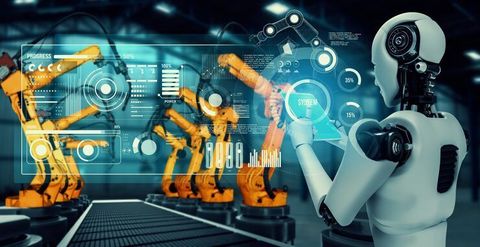
The AI Revolution in 2026: Explore How Artificial Intelligence Is Transforming Industries
The AI Revolution in 2026 represents a major shift in how people, businesses, governments, and industries use technology. Artificial Intelligence (AI) refers to computer systems designed to perform tasks that normally require human intelligence, such as understanding language, identifying patterns, analyzing information, recognizing images, and supporting decisions. These technologies are becoming part of everyday activities, from digital communication and online education to manufacturing and healthcare.
The development of Artificial Intelligence began several decades ago, when researchers started exploring whether computers could imitate aspects of human thinking. Early systems followed predefined instructions and performed limited calculations. Improvements in computing power, data availability, and machine learning gradually allowed computers to recognize patterns and complete more complex tasks.
Today, AI includes several interconnected technologies, including machine learning, natural language processing, computer vision, robotics, and generative AI. Each technology has different applications, but together they are changing how information is processed and how everyday activities are performed.
How Artificial Intelligence Has Developed
Traditional computer programs generally follow instructions written by developers. AI systems can also learn patterns from training information and use those patterns to produce predictions, classifications, or responses.
Some important developments include:
Machine Learning: Enables computer systems to identify patterns in information and improve their performance through training.
Natural Language Processing: Helps computers understand, interpret, and generate human language.
Computer Vision: Allows systems to analyze photographs, videos, and visual information.
Generative AI: Produces text, images, audio, computer code, and other content based on user instructions.
Robotics: Combines software, sensors, and mechanical systems to perform physical activities.
The growing combination of these technologies explains why the AI Revolution is influencing industries that previously relied heavily on manual processes and traditional computer programs.
Importance
Artificial Intelligence matters because organizations and individuals increasingly need to process large amounts of information, manage complicated activities, and respond to changing circumstances. AI can support these activities by identifying patterns, organizing information, and performing repetitive operations.
Its influence extends beyond technology companies. Healthcare professionals, teachers, manufacturers, farmers, transportation operators, financial institutions, and public organizations are exploring different applications.
How AI Affects Everyday People
AI already influences many familiar activities. Digital assistants interpret spoken instructions, navigation applications estimate travel conditions, and online platforms use recommendation systems to organize information.
Other everyday applications include:
Communication: Language-processing systems help summarize documents, translate text, and organize written information.
Education: Adaptive learning platforms can adjust educational exercises according to individual progress.
Healthcare: Image-analysis systems can help medical professionals examine scans and identify patterns that require attention.
Transportation: Intelligent navigation systems analyze traffic information and suggest alternative routes.
Agriculture: AI-based monitoring can help identify crop conditions, soil variations, and possible irrigation requirements.
These applications demonstrate that Artificial Intelligence is not limited to advanced laboratories. It increasingly influences ordinary decisions and activities.
Industry Transformation Through AI
Different industries use AI according to their operational requirements. The following table presents examples of its applications.
Industry | Common AI applications | Potential impact |
|---|---|---|
Healthcare | Medical image analysis and patient monitoring | Supports clinical assessment |
Manufacturing | Predictive maintenance and robotics | Improves process monitoring |
Education | Adaptive learning and automated assessment | Supports personalized learning |
Agriculture | Crop monitoring and weather analysis | Helps agricultural planning |
Banking | Fraud detection and transaction monitoring | Identifies unusual activity |
Transportation | Traffic prediction and route planning | Supports transportation management |
Retail | Demand forecasting and inventory analysis | Improves stock planning |
Energy | Electricity demand forecasting | Supports energy management |
Challenges Associated With AI Adoption
Although AI creates new possibilities, its development also introduces practical concerns. Systems may produce inaccurate information, misunderstand instructions, or reflect unfair patterns contained in their training information.
Important challenges include:
Data Privacy: Personal information must be handled carefully when AI systems process sensitive records.
Accuracy: AI-generated information can contain errors and requires appropriate verification.
Employment Changes: Automation may change certain occupational responsibilities and create demand for different technical and analytical abilities.
Cybersecurity: AI can support security monitoring, but it can also be misused to create more convincing digital threats.
Human Oversight: Important decisions involving people should not rely entirely on automated outputs.
Understanding these limitations is important when evaluating the long-term effects of the AI Revolution.
Recent Updates
The period from 2024 to 2026 has brought significant changes in Artificial Intelligence. Generative AI has expanded beyond text generation into image creation, voice interaction, video production, document analysis, and software development. These developments are making AI systems more flexible and useful across different professional environments.
Growth of Generative AI
Generative AI has become an important part of the wider technology landscape. Modern systems can interpret written instructions, analyze uploaded documents, generate computer code, and work with different forms of media.
Multimodal AI is another important development. It allows a single system to process combinations of text, images, audio, and video, making interactions more natural and reducing the need to use separate applications for different tasks.
AI Agents and Automated Workflows
AI agents are gaining attention because they can perform connected activities rather than simply responding to individual questions. Depending on their permissions and design, they may organize information, prepare documents, examine data, and complete several steps within a defined workflow.
However, these systems still require appropriate supervision. Errors in instructions, incomplete information, and unexpected system behavior can affect their results.
Developments Across Major Industries
Recent AI developments are influencing several important areas:
Healthcare: AI-assisted image analysis and research tools are supporting medical investigations and administrative activities.
Manufacturing: Predictive maintenance systems examine equipment information to identify possible operational problems.
Education: AI-based learning applications are supporting language practice, lesson preparation, and personalized educational activities.
Finance: Machine learning systems are being used to examine transactions, identify unusual patterns, and support risk assessment.
Agriculture: Satellite imagery and intelligent monitoring systems are helping farmers examine crop conditions and environmental changes.
Important AI Trends Between 2024 and 2026
Development | Main change | Industry relevance |
|---|---|---|
Generative AI | Produces different types of content | Education and media |
Multimodal AI | Processes multiple information formats | Healthcare and communication |
AI agents | Handles connected tasks | Administration and technology |
Edge AI | Processes information directly on local devices | Manufacturing and transportation |
Responsible AI | Focuses on transparency and accountability | Government and business |
Another important trend is the development of smaller AI models that can operate on personal computers, mobile devices, and industrial equipment. This approach can reduce dependence on distant computing infrastructure and support applications where rapid responses or local data processing are important.
Laws or Policies
Artificial Intelligence is developing within an increasingly complex regulatory environment. Governments are introducing policies to address data protection, discrimination, transparency, cybersecurity, and accountability. The exact requirements differ between countries and industries.
Artificial Intelligence Regulations in India
India's approach focuses on responsible AI development while encouraging technological innovation and wider adoption. The Ministry of Electronics and Information Technology (MeitY) released the India AI Governance Guidelines in November 2025.
The framework establishes seven guiding principles, including human oversight, fairness, accountability, transparency, safety, and inclusive development. It also emphasizes using existing legal frameworks to address risks associated with AI applications.
Important laws that may apply to AI-related activities include:
Digital Personal Data Protection Act, 2023: Establishes a framework for processing digital personal information and protecting individual privacy.
Information Technology Act, 2000: Addresses various electronic activities, cybersecurity matters, and certain technology-related offences.
Copyright Act, 1957: Provides rules concerning copyright protection and the use of protected creative material.
Consumer Protection Act, 2019: Addresses consumer rights and misleading commercial practices that may involve technology-based activities.
AI developers and organizations must consider applicable legal requirements when collecting information, developing systems, or using automated technologies.
Artificial Intelligence Regulations in Other Regions
Different countries are following different approaches to AI governance.
European Union: The EU AI Act establishes a risk-based regulatory framework. Certain prohibited practices and AI literacy requirements became applicable in February 2025, while obligations for general-purpose AI models began in August 2025. Most remaining provisions, including important transparency requirements, become applicable in August 2026. Certain high-risk system requirements have later implementation dates.
United States: AI governance involves federal policies, existing privacy and consumer protection laws, and state-level legislation. Requirements can vary according to the application and jurisdiction.
International cooperation: Organizations such as the OECD and UNESCO have developed principles and guidance addressing responsible AI, human rights, transparency, and accountability.
These developments show that AI regulation is becoming an important part of technology governance. Organizations must consider both technological capabilities and the legal responsibilities associated with their applications.
Tools and Resources
Several digital platforms and educational resources help individuals understand, evaluate, and work with Artificial Intelligence. Their usefulness depends on the intended activity, technical knowledge, and information requirements.
Common AI Tools and Platforms
Some widely recognized AI platforms and technologies include:
ChatGPT: Supports text generation, document analysis, explanations, brainstorming, and general information processing.
Google Gemini: Provides AI-assisted research, content understanding, and multimodal interactions.
Microsoft Copilot: Supports document-related activities, information processing, and workplace productivity.
TensorFlow: An open-source framework used to develop and train machine learning models.
PyTorch: A machine learning framework used in research, experimentation, and AI development.
Hugging Face: Provides access to machine learning models, datasets, and development resources.
Educational and Research Resources
People interested in understanding AI can explore several learning resources:
Google AI: Educational materials explaining artificial intelligence and machine learning concepts.
IBM SkillsBuild: Learning materials covering AI fundamentals and digital technology.
Kaggle: Datasets, educational exercises, and machine learning projects.
OECD AI Policy Observatory: Information about international AI policies, governance, and developments.
UNESCO: Research and guidance concerning AI ethics, education, and social implications.
These resources cover different levels of technical knowledge, from introductory explanations to practical model development.
FAQs
1. What is the AI Revolution in 2026?
The AI Revolution refers to the growing use of Artificial Intelligence across industries and everyday activities. In 2026, developments in generative AI, automation, robotics, and multimodal systems are expanding its applications.
2. How is Artificial Intelligence transforming different industries?
Artificial Intelligence is supporting healthcare analysis, manufacturing automation, educational tools, financial monitoring, agricultural planning, and transportation management. Its applications differ according to industry requirements.
3. Will Artificial Intelligence replace human workers?
AI may automate certain repetitive activities and change responsibilities in several occupations. However, many activities still require human judgment, communication, creativity, accountability, and practical experience.
4. What are the main risks associated with the AI Revolution?
Important risks include inaccurate information, privacy concerns, algorithmic bias, cybersecurity threats, intellectual property disputes, and excessive dependence on automated decisions.
5. What skills are important in an Artificial Intelligence-driven world?
Digital literacy, critical thinking, analytical abilities, communication, problem-solving, and an understanding of AI limitations are increasingly relevant across different professional fields.
Conclusion
The AI Revolution in 2026 is changing how industries process information, manage operations, and approach complex activities. Artificial Intelligence is creating new possibilities in healthcare, education, manufacturing, agriculture, finance, and transportation. However, concerns involving privacy, accuracy, security, fairness, and accountability remain important. Its long-term influence will depend on technological development, responsible implementation, appropriate regulation, and effective human oversight.

Related Post...

Evolution of Cyber Threats: Discover the History and Growth of Cybercrime
Updated: November 25, 2026
Read More
Essential Tips for Understanding Smart Temperature Sensors and Their Functions
Updated: November 25, 2026
Read More
AI and ML Security Risks Guide: Understanding Vulnerabilities and Emerging Threats
Updated: November 25, 2026
Read More