Essential Tips for Understanding Smart Temperature Sensors and Their Functions
Smart temperature sensors are electronic devices designed to measure temperature, process measurement data, and communicate information to other digital systems. Unlike traditional thermometers, which mainly display temperature readings, smart temperature sensors can provide continuous monitoring, automatic notifications, data recording, and remote access.
These sensors combine temperature-sensitive components with electronic circuits, microcontrollers, and communication technologies. Depending on their design, they can transmit information through Wi-Fi, Bluetooth, Zigbee, LoRaWAN, or industrial communication protocols.
Smart temperature sensors are increasingly used in manufacturing, healthcare, agriculture, transportation, food storage, and smart buildings. Their development is closely connected to the growth of the Internet of Things (IoT), industrial automation, and data-driven monitoring.
How Smart Temperature Sensors Work
A smart temperature sensor generally follows a simple measurement process:
Temperature detection: A sensing element detects changes in the surrounding temperature.
Signal conversion: Electronic circuits convert the detected changes into electrical signals.
Data processing: A microcontroller processes the measurement and prepares it for transmission.
Communication: The sensor sends readings to a connected device, gateway, or cloud platform.
Monitoring: Users can review temperature information through dashboards, applications, or monitoring systems.
Several sensing technologies are used in these devices, including thermistors, resistance temperature detectors (RTDs), thermocouples, and semiconductor temperature sensors.
Types of Smart Temperature Sensors
Different sensor technologies are suitable for different operating conditions and measurement requirements.
| Sensor Type | Working Principle | Common Applications |
|---|---|---|
| Thermistor | Resistance changes with temperature | Home appliances and HVAC |
| RTD | Electrical resistance changes with temperature | Industrial process monitoring |
| Thermocouple | Generates voltage from temperature differences | Furnaces and manufacturing |
| Semiconductor Sensor | Uses semiconductor characteristics | Electronics and smart devices |
| Infrared Sensor | Detects thermal radiation | Non-contact temperature monitoring |
The selection depends on measurement range, accuracy, response time, environmental conditions, and installation requirements.
Why Smart Temperature Sensors Matter Today
Temperature monitoring plays an important role in maintaining equipment performance, product quality, environmental conditions, and operational safety. Even small temperature changes can affect sensitive materials, industrial processes, electronic components, and stored products.
Smart temperature sensors help organizations identify unusual temperature conditions before they develop into larger operational problems.
Industrial Automation and Manufacturing
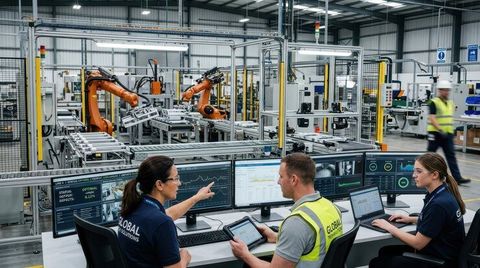
Manufacturing facilities use temperature monitoring to observe machinery, production equipment, industrial ovens, and processing systems.
These sensors help operators identify overheating conditions, monitor production consistency, and maintain suitable operating temperatures. Continuous measurements can also support predictive maintenance by highlighting unusual temperature patterns.
Healthcare and Pharmaceutical Monitoring
Temperature stability is important for many medical products, laboratory materials, vaccines, and pharmaceutical storage environments.
Smart temperature monitoring systems can record readings continuously and generate alerts when temperatures move beyond predefined limits. Historical records also help organizations review storage conditions and investigate possible temperature-related incidents.
Food Storage and Cold Chain Management
Food processing facilities, refrigerated warehouses, and transportation operators depend on temperature monitoring to maintain appropriate storage conditions.
Smart sensors can track temperatures in refrigerators, freezers, and refrigerated transportation units. Automated alerts help operators identify equipment failures or unexpected temperature changes.
Smart Buildings and Energy Management
Modern buildings use temperature sensors to support heating, ventilation, and air conditioning (HVAC) systems.
These devices help regulate indoor temperatures according to occupancy, environmental conditions, and operating schedules. They can also contribute to energy monitoring and automated building management.
Agriculture and Environmental Monitoring
Agricultural operations use smart sensors to monitor greenhouse temperatures, soil conditions, storage environments, and livestock facilities.
Temperature information can help farmers understand environmental changes and manage controlled growing conditions.
Recent Developments and Technology Trends
Smart temperature sensor technology continues to evolve through improvements in wireless communication, low-power electronics, cloud computing, and artificial intelligence.
Developments during 2025 and 2026 have also increased attention toward connected-device cybersecurity, interoperability, and long-term IoT monitoring.
Wireless Temperature Monitoring
Wireless temperature sensors are becoming increasingly relevant in industrial environments, warehouses, laboratories, and commercial buildings.
Technologies such as Bluetooth Low Energy, Wi-Fi, and LoRaWAN allow measurement information to travel without traditional wired connections. This can simplify installation in locations where physical wiring is difficult.
Artificial Intelligence and Predictive Analytics
AI-based monitoring systems can examine historical temperature readings and identify unusual patterns.
For example, repeated temperature increases in industrial equipment may indicate changing operating conditions. Predictive analytics can help maintenance teams investigate potential problems before equipment performance is affected.
However, these systems depend on reliable sensor data and appropriate analytical models.
Improved IoT Cybersecurity
Connected temperature monitoring devices increasingly require attention to data protection, authentication, secure communication, and software maintenance.
In April 2026, the US National Institute of Standards and Technology (NIST) published NISTIR 8259 Revision 1, which describes foundational activities for IoT product manufacturers. Its guidance addresses security considerations throughout device development and support.
Advances in Cold Chain Monitoring
India's National Centre for Cold Chain Development published its second edition of engineering guidelines and minimum system standards in 2025. The document discusses IoT-based remote monitoring of temperature, humidity, and energy consumption in cold storage environments.
These developments demonstrate the growing importance of connected monitoring systems in storage and logistics operations.
Miniaturization and Low-Power Technology
Manufacturers continue to develop smaller sensing components with lower energy requirements.
These improvements are relevant to battery-powered wireless sensors, portable monitoring devices, and installations where replacing batteries frequently may be difficult.
Laws, Regulations, and Industry Standards
Smart temperature sensors are affected by different regulations depending on their location, intended application, communication technology, and measurement purpose.
There is no single international law covering every type of smart temperature sensor. Instead, manufacturers and operators may need to consider electrical safety, radio communication, cybersecurity, data protection, and measurement requirements.
European Union Regulations
The European Union's Radio Equipment Directive (RED) 2014/53/EU establishes requirements for radio-enabled devices. Relevant requirements cover health and safety, electromagnetic compatibility, and efficient use of radio spectrum.
From August 1, 2025, additional cybersecurity requirements under Delegated Regulation (EU) 2022/30 became applicable to certain categories of connected radio equipment.
The EU Cyber Resilience Act (Regulation 2024/2847) introduces broader cybersecurity requirements for products with digital elements. Its main obligations will apply from December 11, 2027.
In February 2026, the European Commission adopted Delegated Regulation (EU) 2026/339 to repeal the overlapping radio-equipment cybersecurity regulation from December 11, 2027.
United States Regulations
In the United States, smart temperature monitoring equipment may need to comply with applicable Federal Communications Commission (FCC) requirements when it uses radio-frequency communication.
The National Institute of Standards and Technology (NIST) provides cybersecurity guidance for IoT manufacturers and connected-device systems.
Temperature monitoring in pharmaceutical, laboratory, and food-related environments may also be affected by sector-specific requirements.
India's Regulatory Environment
In India, applicable requirements can include the Bureau of Indian Standards (BIS) framework, relevant electrical safety requirements, and Department of Telecommunications regulations for wireless equipment.
The Wireless Planning and Coordination Wing (WPC) oversees relevant radio-frequency spectrum requirements, including applicable equipment approvals and exemptions.
For pharmaceutical and food storage applications, organizations should also consider relevant requirements established by the Central Drugs Standard Control Organisation (CDSCO), Food Safety and Standards Authority of India (FSSAI), and other applicable authorities.
Important Compliance Considerations
Organizations evaluating smart temperature monitoring equipment should review:
Applicable electrical and electronic safety standards.
Wireless communication and frequency requirements.
Calibration and measurement accuracy.
Data privacy and cybersecurity practices.
Industry-specific temperature monitoring requirements.
Documentation, maintenance, and measurement records.
Regulatory obligations depend on the equipment and its intended use. Organizations should verify current requirements with the relevant authorities.
Tools and Resources for Smart Temperature Monitoring
Several technical tools and digital platforms help users understand, configure, analyze, and maintain smart temperature monitoring systems.
Temperature Monitoring and Data Analysis
NI LabVIEW: Used for measurement automation, sensor integration, and data visualization.
MATLAB: Supports temperature data analysis, mathematical modeling, and signal processing.
Microsoft Excel: Helps organize temperature readings, create trend charts, and calculate measurement averages.
Grafana: Supports monitoring dashboards and visualization of time-series sensor information.
IoT Platforms and Device Management
AWS IoT Core: Supports communication and management of connected IoT devices.
Microsoft Azure IoT: Provides tools for connected-device monitoring and data integration.
ThingsBoard: Supports IoT dashboards, device management, and monitoring workflows.
Arduino IDE: Helps developers program compatible microcontrollers and temperature sensor modules.
Technical Standards and Reference Resources
NIST: Provides measurement science and IoT cybersecurity guidance.
IEC: Publishes international standards relating to electrical equipment, instrumentation, and measurement.
ISO: Provides standards relevant to quality management, measurement processes, and industrial operations.
BIS: Provides Indian standards and conformity-related information.
These resources can support different stages of sensor selection, development, testing, deployment, and monitoring.
Frequently Asked Questions
1. What is a smart temperature sensor?
A smart temperature sensor is an electronic device that measures temperature, processes the readings, and communicates the information to connected systems. It can support automated monitoring, historical data recording, and alerts.
2. How are smart temperature sensors different from traditional temperature sensors?
Traditional temperature sensors generally provide a measurement through an analog or digital output. Smart temperature sensors can include additional processing, wireless communication, data logging, and integration with IoT platforms.
3. Which industries use smart temperature sensors?
Common applications include manufacturing, healthcare, pharmaceutical storage, food processing, agriculture, transportation, laboratories, and smart buildings. Their purpose is to monitor environmental and equipment temperature conditions.
4. Can smart temperature sensors monitor temperature remotely?
Yes. Wireless sensors can transmit readings to connected gateways or cloud platforms. Authorized users can review the information through compatible dashboards or applications, depending on the system's communication capabilities.
5. How often should smart temperature sensors be calibrated?
Calibration frequency depends on the sensor type, operating environment, measurement accuracy requirements, and applicable industry regulations. Some applications require periodic calibration, while others may need more frequent verification. Manufacturers and relevant measurement standards provide guidance for determining suitable intervals.
Conclusion
Smart temperature sensors are an important part of modern measurement and automation systems. By combining temperature detection, electronic processing, wireless communication, and digital monitoring, they help organizations understand changing environmental and equipment conditions.
Their applications extend across manufacturing, healthcare, agriculture, food storage, transportation, and building management. Developments in IoT connectivity, artificial intelligence, low-power electronics, and cybersecurity are continuing to influence how these systems are designed and implemented.
As connected monitoring becomes more common, measurement accuracy, calibration, data protection, interoperability, and regulatory compliance will remain important considerations. Understanding these factors helps organizations evaluate smart temperature sensor technologies and identify suitable applications for different operating environments.

Related Post...
Explore Smart Sensors and Actuators: Technology, Applications, and Uses
Updated: November 03, 2026
Read More
Essential Tips for Understanding Data Center Virtualization Technologies
Updated: November 03, 2026
Read More