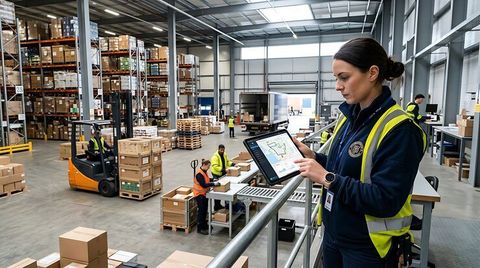
Explore the Future of Smart Manufacturing: Global Trends to Watch in 2027
Smart manufacturing is changing how factories, industrial facilities, and production networks operate. It combines advanced technologies such as artificial intelligence (AI), industrial Internet of Things (IIoT), robotics, cloud computing, machine learning, and data analytics to improve production processes.
Traditional manufacturing often depends on manual monitoring, scheduled maintenance, and separate production systems. Smart manufacturing connects machines, equipment, software, and employees through digital networks. This allows industrial facilities to collect information, monitor operations, and make decisions using real-time data.
As industries prepare for 2027, the focus is shifting towards intelligent automation, connected production systems, industrial cybersecurity, and sustainable manufacturing. These developments are influencing automotive production, electronics, aerospace, pharmaceuticals, food processing, and heavy engineering.
The future of manufacturing will not depend on automation alone. It will increasingly involve combining human expertise with intelligent technologies to create flexible, reliable, and data-driven production environments.
How Smart Manufacturing Works
A smart manufacturing environment connects different technologies to create a coordinated production system.
Industrial IoT: Connects machines, sensors, and production equipment to collect operational data.
Artificial Intelligence: Analyzes information to identify patterns and support production decisions.
Industrial Robotics: Performs repetitive, precise, and complex manufacturing activities.
Digital Twins: Creates virtual representations of physical equipment, production lines, or entire facilities.
Cloud Computing: Supports data storage, remote monitoring, and connected industrial applications.
Predictive Maintenance: Uses equipment data to identify possible failures before major interruptions occur.
These technologies work together to improve visibility across manufacturing operations.
Why Smart Manufacturing Matters Today
Manufacturing companies face several challenges, including changing customer requirements, supply chain disruptions, energy consumption, production delays, and increasing quality expectations. Smart manufacturing provides technological approaches to address these issues.
Its importance extends beyond large industrial companies. Small and medium-sized manufacturers, equipment manufacturers, technology developers, and industrial workers are also affected by digital transformation.
Improving Production Efficiency
Connected equipment can provide continuous information about machine performance, production speed, and operational conditions.
Manufacturers can use this information to identify bottlenecks, reduce unnecessary downtime, and improve production planning. Automated production systems also help maintain consistent operating conditions.
Predictive Maintenance and Equipment Reliability
Unexpected equipment failures can interrupt manufacturing activities. Predictive maintenance uses sensors, historical records, and machine learning algorithms to identify unusual operating patterns.
For example, vibration sensors can detect changes in industrial motors, while temperature monitoring can identify abnormal heating conditions.
This approach supports:
Better equipment performance monitoring.
Earlier identification of mechanical problems.
Improved maintenance scheduling.
Reduced unplanned production interruptions.
Quality Control and Industrial Automation
AI-powered quality inspection is becoming an important part of modern production. Computer vision systems can examine manufactured components, identify visible defects, and support quality assurance processes.
Automated inspection is particularly relevant to electronics manufacturing, automotive components, pharmaceutical packaging, and precision engineering.
Energy Management and Sustainable Production
Smart manufacturing also supports industrial energy management. Connected meters and monitoring platforms can identify energy consumption across different machines and production processes.
Manufacturers can use this information to improve energy planning, monitor emissions, and evaluate resource efficiency.
Global Smart Manufacturing Trends to Watch in 2027
The manufacturing landscape is expected to become increasingly connected and intelligent. Several technological developments are likely to influence industrial transformation during 2027.
Artificial Intelligence in Industrial Production
Industrial AI is moving beyond basic data analysis towards more advanced operational applications. Manufacturers are exploring AI models that can analyze production information, identify unusual patterns, and support complex decisions.
Generative AI is also gaining attention for industrial documentation, technical knowledge management, maintenance assistance, and production planning.
One emerging area is agentic AI, where AI systems can coordinate multiple digital tasks within defined operational limits. Human supervision, testing, and cybersecurity controls remain essential.
Growth of Industrial Robotics and Collaborative Robots
Industrial robotics will remain an important part of manufacturing automation. Traditional robotic systems perform repetitive activities such as welding, painting, assembly, and material handling.
Collaborative robots, commonly called cobots, are designed to operate alongside human workers in appropriately assessed environments.
In 2027, manufacturers are likely to focus on:
AI-enabled robotic inspection.
Flexible robotic assembly systems.
Automated material handling.
Human-robot collaboration.
Autonomous mobile robots in warehouses.
Digital Twins and Virtual Factory Planning
Digital twin technology creates a virtual representation of a physical manufacturing system. It uses information from sensors, engineering models, and operational databases.
Manufacturers can use digital twins to examine production performance, test operational changes, and evaluate different factory configurations before implementing physical modifications.
This technology is particularly relevant to complex industrial environments where equipment performance and production coordination are important.
Industrial Internet of Things and 5G Connectivity
IIoT networks connect production equipment, sensors, control systems, and industrial applications.
The expansion of private 5G networks and advanced wireless technologies may support faster communication, mobile robotics, and connected industrial monitoring.
Reliable connectivity will be especially important for large factories with multiple production areas and automated material movement systems.
Cybersecurity for Connected Factories
As manufacturing equipment becomes more connected, cybersecurity risks also increase. Industrial networks may face ransomware, unauthorized access, data theft, and operational disruptions.
Manufacturers are increasingly considering network segmentation, access controls, secure software updates, continuous monitoring, and incident response planning.
Cybersecurity will remain a major requirement for smart factories in 2027.
Flexible and Modular Manufacturing Systems
Manufacturing facilities are increasingly adopting flexible production systems that can accommodate different product designs and changing production requirements.
Modular manufacturing allows individual production units to be reorganized or upgraded without redesigning an entire facility.
This approach is particularly useful in:
Automotive manufacturing.
Consumer electronics production.
Industrial machinery.
Pharmaceutical manufacturing.
Customized component production.
Flexible manufacturing systems may also combine robotics, automated material handling, and AI-based production scheduling.
Sustainable and Low-Carbon Manufacturing
Environmental performance is becoming an important consideration in industrial planning. Manufacturers are examining how digital technologies can support energy efficiency, material optimization, waste reduction, and emissions monitoring.
In 2027, smart energy management, industrial resource monitoring, and circular manufacturing practices are expected to remain important areas of development.
Recent Developments and Industry Updates
Developments during 2025 and 2026 provide useful indications of how manufacturing technology may evolve in 2027.
Important Developments During 2025–2026
Date | Development | Manufacturing relevance |
|---|---|---|
September 2025 | NIST released its Cybersecurity Framework 2.0 Manufacturing Profile draft. | Strengthens guidance for industrial cybersecurity and supply chain risk management. |
April 2026 | NIST published updated IoT cybersecurity guidance. | Highlights security considerations for connected industrial products. |
July 2026 | NIST published its AI and Machine Learning Roadmap for Smart Manufacturing. | Examines AI, robotics, digital twins, and intelligent industrial systems. |
September 2026 | International Federation of Robotics reported five million industrial robots operating worldwide in 2025. | Demonstrates the continuing expansion of industrial automation. |
These developments indicate that industrial transformation involves more than installing automated machinery. Data management, cybersecurity, AI reliability, and integration between different technologies are becoming equally important.
Industrial AI Adoption
A major development in 2026 has been the growing focus on implementing AI across manufacturing operations. Research published by NIST in July 2026 identifies industrial data analytics, autonomous systems, advanced sensing, robotics, and digital twins as important areas for future development.
The roadmap also highlights challenges involving data quality, system integration, reliability, and explainable AI. These issues will influence how manufacturers introduce AI into operational environments.
Expansion of Industrial Robotics
The International Federation of Robotics reported in September 2026 that the worldwide operational stock of industrial robots reached approximately five million units in 2025. More than 600,000 new industrial robots were installed during that year.
Asia remained the largest regional market for industrial robot deployment, with China accounting for a particularly significant share.
This expansion suggests that robotics will continue to influence assembly, inspection, material handling, and automated production planning in 2027.
Laws, Regulations, and Government Policies
Smart manufacturing operates within different legal and regulatory environments. Requirements depend on the country, industry, equipment, data being processed, and level of automation.
There is no single international law covering every aspect of smart manufacturing. However, several important regulatory frameworks influence industrial technology adoption.
European Union
The European Union has introduced regulations that affect industrial AI, machinery safety, data protection, and cybersecurity.
Important frameworks include:
EU AI Act: Establishes requirements for certain AI applications, including systems classified as high-risk. Following 2026 amendments, relevant high-risk AI requirements have application dates of December 2027 or August 2028, depending on the system category.
Machinery Regulation (EU) 2023/1230: Establishes safety requirements for machinery and related products. It generally applies from 20 January 2027.
GDPR: Regulates the processing of personal information, including information collected through certain connected workplace technologies.
Manufacturers operating in European markets should evaluate applicable safety, documentation, data protection, and AI compliance requirements.
United States
In the United States, manufacturing facilities must consider workplace safety requirements administered by the Occupational Safety and Health Administration (OSHA).
The National Institute of Standards and Technology (NIST) also provides cybersecurity frameworks and technical guidance for industrial environments.
Its Cybersecurity Framework 2.0 Manufacturing Profile provides a voluntary, risk-based approach to protecting manufacturing systems, industrial networks, and technology infrastructure.
India
India's manufacturing transformation is supported by initiatives such as the SAMARTH Udyog Bharat 4.0 programme, which promotes awareness and adoption of Industry 4.0 technologies.
The Production Linked Incentive (PLI) programmes also support manufacturing development across selected sectors.
Manufacturers must additionally consider applicable factory safety, environmental protection, data protection, and electrical safety requirements.
International Standards
Manufacturers operating across international markets may also consider:
ISO 9001 for quality management systems.
ISO 14001 for environmental management.
ISO 27001 for information security management.
IEC 62443 for industrial automation and control system cybersecurity.
ISO 10218 for industrial robot safety.
The relevant requirements depend on the equipment, facility, and applicable national regulations.
Tools and Resources for Smart Manufacturing
Manufacturers can use specialized industrial software and technical resources to plan, monitor, and improve digital production environments.
Tool or resource | Main application |
|---|---|
Siemens Opcenter | Manufacturing execution system (MES) and production management. |
PTC ThingWorx | Industrial IoT connectivity and operational monitoring. |
Microsoft Azure IoT | Connected equipment and industrial data analytics. |
NVIDIA Omniverse | Industrial digital twins and factory simulation. |
IBM Maximo | Asset management and predictive maintenance. |
Rockwell Automation FactoryTalk | Industrial automation and production monitoring. |
NIST Cybersecurity Framework | Industrial cybersecurity risk management. |
Other important technology areas include:
Industrial automation software.
AI-powered quality inspection.
Predictive maintenance software.
Digital twin platforms.
SCADA systems.
Robotics integration and machine vision technology.
These resources can help manufacturers evaluate technological requirements and develop structured digital transformation plans.
Frequently Asked Questions
What is the future of smart manufacturing in 2027?
Smart manufacturing in 2027 is expected to focus on industrial AI, advanced robotics, digital twins, connected equipment, predictive maintenance, and cybersecurity. These technologies will support more intelligent and flexible production environments.
How does artificial intelligence improve manufacturing?
AI analyzes production data, identifies unusual equipment conditions, supports quality inspection, and improves production planning. It can also help manufacturers identify operational patterns that may be difficult to detect through manual monitoring.
What is the role of digital twins in smart factories?
Digital twins create virtual representations of physical manufacturing equipment and production systems. They help engineers simulate operations, evaluate changes, and monitor equipment performance using connected data.
Why is industrial cybersecurity important?
Connected manufacturing systems can face cyberattacks, unauthorized access, and operational disruptions. Industrial cybersecurity helps protect production networks, sensitive information, connected equipment, and critical infrastructure.
Will robotics replace traditional manufacturing processes?
Robotics will automate many repetitive and precision-based activities. However, human expertise will remain important for supervision, engineering, maintenance, quality decisions, and complex problem-solving.
Conclusion
Smart manufacturing is entering an important stage of technological development. In 2027, industrial AI, robotics, digital twins, IIoT connectivity, and cybersecurity will continue shaping global production environments. Manufacturers that understand these developments can make informed decisions about automation, operational efficiency, and sustainable production. The long-term direction of manufacturing will depend on balancing technological innovation, workforce capabilities, safety, and responsible digital transformation.

Related Post...
Explore the Future of Smart Manufacturing: Global Trends to Watch in 2027
Updated: November 26, 2026
Read More
Explore How Artificial Intelligence Is Transforming Global Manufacturing Industries
Updated: November 26, 2026
Read More
A Guide to Understanding Humanoid Robots and the Future of Manufacturing Jobs
Updated: November 26, 2026
Read More