Explore Smart Sensors and Actuators: Technology, Applications, and Uses
Smart sensors and actuators are important components of modern automation, industrial Internet of Things (IIoT) systems, and intelligent control technologies. They help machines, buildings, vehicles, and industrial equipment collect information, interpret conditions, and respond to changes automatically. These technologies connect physical environments with digital systems, making operations more responsive and data-driven.
A smart sensor detects physical conditions such as temperature, pressure, humidity, movement, vibration, light, and chemical levels. Unlike traditional sensors, smart sensors often include integrated processing capabilities, digital communication interfaces, and built-in diagnostic functions. These features allow them to process measurements and transmit useful information to connected systems.
Actuators perform the opposite but complementary function. They receive control signals and convert them into physical actions, including movement, rotation, opening, closing, heating, or pressure adjustment. Electric motors, hydraulic cylinders, pneumatic valves, and robotic actuators are common examples.
Together, smart sensors and actuators create an essential foundation for automated systems. Sensors provide information about the surrounding environment, while actuators execute commands based on that information.
How Smart Sensors and Actuators Work
The operation of an integrated sensor and actuator system generally follows a continuous monitoring and control process.
Data collection: Sensors measure environmental or equipment conditions.
Signal processing: Embedded electronics process measurements and identify relevant changes.
Data communication: Information travels through wired or wireless networks to controllers or monitoring platforms.
Decision-making: Programmable logic controllers (PLCs), microcontrollers, or industrial software evaluate the information.
Physical response: Actuators receive commands and perform the required operation.
Continuous feedback: Sensors measure the results to determine whether the desired conditions have been achieved.
For example, an automated temperature control system uses a temperature sensor to monitor room conditions. When the temperature moves beyond a programmed range, a controller sends instructions to an actuator that adjusts a ventilation valve or heating mechanism.
Major Types of Smart Sensors and Actuators
Smart sensors are available in several categories depending on their measurement capabilities and intended applications.
Temperature sensors: Monitor heat levels in industrial equipment, buildings, refrigeration systems, and manufacturing environments.
Pressure sensors: Measure pressure in pipelines, hydraulic systems, compressors, and industrial machinery.
Proximity sensors: Detect nearby objects without requiring direct physical contact.
Motion sensors: Identify movement and changes in position for security, robotics, and automated lighting.
Vibration sensors: Monitor mechanical equipment to identify unusual operating conditions.
Humidity sensors: Measure moisture levels in agricultural environments, warehouses, and climate control systems.
Chemical sensors: Detect particular gases, substances, or changes in chemical composition.
Actuators also have different operating mechanisms.
Electric actuators: Use electrical energy to generate controlled mechanical movement.
Pneumatic actuators: Use compressed air to operate valves, cylinders, and industrial mechanisms.
Hydraulic actuators: Use pressurized fluid to produce substantial mechanical force.
Thermal actuators: Use temperature-related changes to generate movement.
Piezoelectric actuators: Produce precise movement through electrical stimulation of specialized materials.
Why Smart Sensors and Actuators Matter Today
Smart sensors and actuators have become increasingly important because industries require accurate monitoring, improved operational visibility, and reliable automated control. They help organizations understand equipment conditions and respond to changing operational requirements.
Their importance extends across manufacturing, transportation, healthcare equipment, agriculture, energy management, and smart infrastructure.
Industrial Automation and Predictive Maintenance
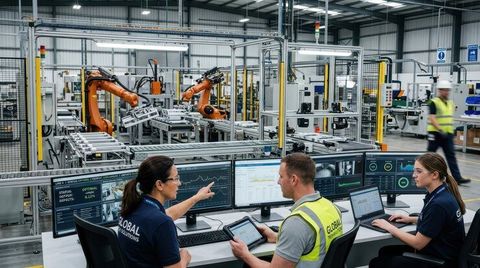
Industrial automation systems use smart sensors to monitor machinery, production lines, and operating environments. Vibration and temperature measurements can help identify unusual equipment behavior before a major failure occurs.
Predictive maintenance sensors provide information that maintenance teams can analyze to identify developing problems. This approach can support better maintenance planning, reduce unexpected interruptions, and improve equipment reliability.
Smart Buildings and Energy Management
Smart building automation systems combine occupancy sensors, temperature monitoring, lighting controls, and automated actuators.
These technologies help building management systems adjust ventilation, lighting, and temperature according to environmental conditions. They can also provide information about energy consumption and equipment performance.
Agriculture and Environmental Monitoring
Precision agriculture sensors measure soil moisture, temperature, humidity, and other environmental conditions. Connected irrigation systems can use this information to determine when water distribution adjustments are required.
Environmental monitoring applications also use smart sensors to measure air quality, water conditions, and industrial emissions.
Robotics and Intelligent Manufacturing
Robotics depends on accurate sensing and controlled movement. Position sensors, force sensors, proximity detectors, and robotic actuators help machines perform repetitive tasks with greater consistency.
These technologies support automated assembly, material handling, inspection, and advanced manufacturing operations.
Recent Developments and Technology Trends (2025–2026)
The smart sensor and actuator industry continues to develop through improvements in artificial intelligence, wireless connectivity, embedded computing, and industrial cybersecurity.
Several developments during 2025 and 2026 demonstrate the direction of this technology.
Artificial Intelligence at the Edge
Edge AI is becoming increasingly relevant to industrial sensor networks. Instead of transmitting every measurement to a centralized cloud platform, connected devices can process selected information locally.
This approach can help reduce communication delays, support faster responses, and improve monitoring in environments where continuous network connectivity is difficult.
Growth of Industrial IoT Connectivity
Industrial IoT systems increasingly combine smart sensors, automated controllers, and connected equipment. Wireless communication technologies allow organizations to monitor equipment across larger facilities without depending entirely on traditional wired connections.
Connectivity methods such as Bluetooth Low Energy, Wi-Fi, industrial Ethernet, and 5G support different requirements involving range, reliability, and communication speed.
Improved IoT Cybersecurity Guidance
On April 20, 2026, the National Institute of Standards and Technology (NIST) published Revision 1 of its IR 8259 guidance for IoT product manufacturers. The updated publication emphasizes cybersecurity activities throughout product development and support, including maintenance, customer communication, and end-of-life considerations.
This development is relevant to connected sensors and actuators because these devices increasingly exchange information with industrial networks and digital platforms.
Secure Device Network Integration
On November 25, 2025, NIST published guidance on trusted IoT device onboarding and lifecycle management. The publications explain approaches for establishing trust between connected devices and networks before granting network access.
Such measures are important for industrial environments containing large numbers of connected sensors, controllers, and actuators.
Standardization of Smart Transducer Technology
Interoperability remains an important development area. IEEE 1451.0-2024 provides common functions and communication approaches for smart transducers, including sensors and actuators. Standardized interfaces can help different components exchange information more consistently.
Laws, Regulations, and Industry Standards
Smart sensors and actuators are affected by several regulatory frameworks because they can involve electronic safety, wireless communication, data collection, industrial operations, and cybersecurity.
Requirements vary according to the country, application, product category, and operating environment.
European Union
The European Union's Cyber Resilience Act (CRA) establishes cybersecurity requirements for products with digital elements.
The legislation entered into force on December 10, 2024. Its main requirements will apply from December 11, 2027, while mandatory reporting obligations for actively exploited vulnerabilities and severe incidents began on September 11, 2026.
Connected sensors, smart controllers, and industrial IoT products may fall within its scope depending on their characteristics and market placement.
United States
The United States has introduced the IoT Cybersecurity Improvement Act of 2020, which establishes a framework for cybersecurity requirements relating to IoT devices used by federal agencies.
NIST provides technical guidance that helps organizations and manufacturers address device cybersecurity, risk management, and secure development.
India
India's Department of Telecommunications, through the Telecommunication Engineering Centre (TEC), develops technical guidance and standards relating to telecommunications and IoT technologies.
On November 28, 2025, TEC released Version 2.0 of its Code of Practice for Securing Consumer Internet of Things (IoT).
Organizations developing or deploying connected sensor systems should also consider applicable wireless equipment requirements, electrical safety standards, data protection obligations, and relevant industrial regulations.
Important International Standards
The following standards and frameworks provide useful technical guidance:
IEC 61508: Functional safety of electrical, electronic, and programmable electronic safety-related systems.
ISO 13849: Safety-related parts of machinery control systems.
IEEE 1451: Smart transducer interfaces for sensors and actuators.
IEC 62443: Cybersecurity for industrial automation and control systems.
NIST IoT Cybersecurity Guidance: Recommendations for improving the security of connected devices.
Tools and Resources for Smart Sensors and Actuators
Several technical platforms and resources help engineers, researchers, manufacturers, and students understand, develop, and monitor smart sensor and actuator systems.
1. Arduino IDE
An integrated development environment used for programming microcontrollers and testing sensor and actuator applications. It supports prototype development involving temperature sensors, motion detectors, motors, and other electronic components.
2. MATLAB and Simulink
Engineering environments used for modeling, simulation, signal processing, control system development, and analysis of sensor measurements.
3. LabVIEW
A graphical programming environment used for measurement systems, instrument control, automated testing, and data acquisition.
4. Node-RED
A flow-based programming environment that can connect IoT devices, sensors, APIs, and monitoring dashboards.
5. Siemens TIA Portal
An engineering platform used for configuring industrial automation systems, programmable logic controllers, and connected equipment.
6. MQTT Protocol
A lightweight messaging protocol commonly used for communication between connected sensors, controllers, and IoT platforms.
7. ThingsBoard
An IoT platform used for device management, telemetry collection, data visualization, and monitoring connected equipment.
8. NIST Cybersecurity Resources
Technical publications and cybersecurity frameworks that help organizations understand connected-device security and industrial network protection.
9. IEEE Standards Resources
Technical documentation covering smart transducer interfaces, communication protocols, and interoperability requirements.
Frequently Asked Questions
1. What is the main difference between a smart sensor and a traditional sensor?
A traditional sensor primarily detects and converts physical measurements into electrical signals. A smart sensor can include processing capabilities, digital communication, calibration features, and diagnostic functions. These additional capabilities make it easier to integrate smart sensors into automated systems.
2. What are the main applications of smart sensors and actuators?
They are used in industrial automation, smart buildings, robotics, automotive systems, healthcare equipment, precision agriculture, environmental monitoring, and energy management. Their functions include collecting information, controlling equipment, and supporting automated decision-making.
3. How do smart sensors support predictive maintenance?
Smart sensors continuously monitor operating conditions such as temperature, vibration, pressure, and equipment movement. Monitoring platforms can analyze this information to identify unusual patterns and potential equipment problems, helping maintenance teams plan inspections and corrective activities.
4. What communication protocols are commonly used in smart sensor systems?
Common communication technologies include MQTT, Modbus, CAN, OPC UA, Bluetooth Low Energy, Wi-Fi, and industrial Ethernet. The appropriate protocol depends on system requirements, communication distance, reliability, security, and compatibility.
5. What are the main challenges associated with smart sensors and actuators?
Common challenges include cybersecurity threats, interoperability limitations, measurement accuracy, environmental conditions, integration complexity, and maintenance requirements. Organizations must also consider data management, calibration, power consumption, and compatibility with existing automation infrastructure.
Conclusion
Smart sensors and actuators are fundamental technologies in modern industrial automation, intelligent infrastructure, and connected environments. Smart sensors collect information about physical conditions, while actuators transform digital instructions into physical actions.
Their integration supports predictive maintenance, precision agriculture, robotics, energy management, and industrial IoT applications. Developments in edge AI, wireless connectivity, standardized communication, and cybersecurity are expanding their capabilities.
As industries continue adopting connected technologies, understanding smart sensor architecture, actuator mechanisms, communication protocols, and applicable regulatory requirements will remain important. Reliable implementation depends on selecting suitable components, maintaining accurate measurements, securing connected devices, and ensuring compatibility across integrated systems.

Related Post...


Discover Key Insights into Web Server Configuration and Security
Updated: November 02, 2026
Read More
Cloud Resource Optimization: Key Insights into Modern Cloud Computing
Updated: November 03, 2026
Read More