A Complete Guide to IoT Applications in Manufacturing Plants
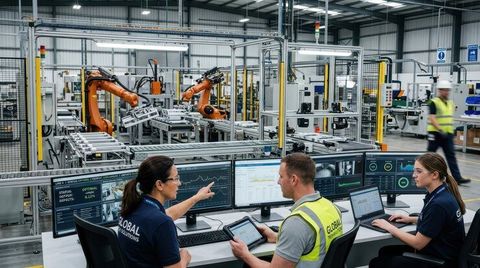
The Internet of Things (IoT) refers to a network of connected physical devices that collect, exchange, and process information through digital communication systems. In manufacturing plants, this technology connects industrial machines, production equipment, sensors, control systems, and software platforms to create a more connected production environment.
Industrial Internet of Things (IIoT) is the term commonly used for IoT applications in industrial environments. It allows manufacturers to monitor equipment conditions, understand production activities, and examine operational data with greater accuracy.
Traditional manufacturing plants often depend on manual inspections and separate machine control systems. Although these methods remain useful, they can make it difficult to understand what is happening across an entire production facility. IoT introduces connected monitoring systems that help bring information from different machines into a shared digital environment.
How IoT works in a manufacturing plant
An industrial IoT system generally includes several connected components:
Sensors: Measure temperature, pressure, vibration, humidity, speed, and other operating conditions.
Connected machines: Transmit operational information through industrial communication networks.
Gateways: Collect information from different devices and transfer it to processing systems.
Cloud and edge computing: Process and store industrial data for monitoring and analysis.
Analytics platforms: Identify patterns, unusual conditions, and operational changes.
Dashboards: Present information through visual reports, alerts, and performance indicators.
For example, a temperature sensor attached to an industrial motor can continuously measure its operating temperature. If the readings move outside an established operating range, the monitoring system can generate an alert for technical inspection.
This connected approach forms an important part of modern smart manufacturing and Industry 4.0.
Why IoT Matters in Modern Manufacturing
Manufacturing plants operate in environments where equipment performance, production schedules, product consistency, and workplace safety are important. Unexpected equipment interruptions or inefficient production processes can affect several connected operations.
IoT technology helps manufacturers understand these conditions through continuous data collection and analysis.
Predictive maintenance and equipment monitoring
Predictive maintenance is one of the most widely discussed applications of industrial IoT. Instead of depending entirely on fixed maintenance schedules, manufacturers can examine equipment data to identify possible signs of deterioration.
Sensors can monitor:
Motor temperature and vibration.
Hydraulic pressure.
Bearing conditions.
Electrical performance.
Machine operating hours.
Equipment speed and load.
These measurements can help maintenance teams recognize unusual patterns before equipment performance becomes seriously affected. Predictive maintenance software can also support maintenance planning by identifying machines that require closer inspection.
Production efficiency and process visibility
IoT platforms provide information about production activities across different machines and manufacturing stages. Managers can examine operating conditions, production quantities, machine availability, and processing times.
This information helps identify production bottlenecks and understand differences between planned and actual performance.
Quality control and product consistency
Connected sensors can monitor manufacturing conditions that influence product quality. For example, food processing plants can monitor temperature and humidity, while metal processing facilities can measure pressure and machine operating conditions.
When measurements move outside approved limits, alerts can help operators investigate the situation.
Energy management and resource monitoring
Industrial facilities use electricity, water, compressed air, and other resources. IoT energy monitoring systems can collect consumption information from individual machines and production areas.
This allows manufacturers to examine:
Electricity consumption by equipment.
Peak energy demand.
Water usage patterns.
Compressed air leakage indicators.
Energy consumption during inactive production periods.
Workplace safety and environmental monitoring
Connected devices can monitor environmental conditions, including air quality, temperature, humidity, and certain industrial gases. Wearable sensors may also support worker-location monitoring in facilities where appropriate safety procedures are established.
These applications can improve operational awareness, although they do not replace safety training, protective equipment, or legally required inspections.
Recent Updates and Emerging IoT Trends in Manufacturing
Industrial IoT is evolving through developments in artificial intelligence (AI), edge computing, digital twins, advanced robotics, and industrial cybersecurity. During 2025 and 2026, manufacturers increasingly focused on connecting these technologies with existing production infrastructure.
Artificial intelligence and industrial IoT integration
AI-powered industrial systems can examine large volumes of sensor information and identify patterns that may not be immediately visible through conventional monitoring.
On July 3, 2026, the US National Institute of Standards and Technology (NIST) published its 2026 Roadmap on Artificial Intelligence and Machine Learning for Smart Manufacturing. It discusses industrial data analytics, advanced sensing, robotics, digital twins, and autonomous manufacturing systems.
Important applications include:
AI-based machine condition monitoring.
Automated visual quality inspection.
Production process optimization.
Industrial robotics coordination.
Data-driven equipment maintenance.
Edge computing and real-time processing
Edge computing processes information close to the machines and sensors that generate it, rather than sending every measurement to a distant cloud platform.
This approach can reduce communication delays and support applications that need rapid responses. It is particularly relevant to automated production lines, robotics, machine vision, and industrial control environments.
Digital twins and virtual manufacturing systems
A digital twin is a digital representation of a physical machine, production line, or manufacturing facility. It uses operational information to help engineers examine equipment performance and simulate different operating conditions.
Manufacturers are increasingly exploring digital twins alongside AI to understand production changes, examine potential equipment problems, and improve factory planning.
Industrial AI and connected operations
A Cisco industrial AI report published in March 2026 highlighted the growing use of AI in live industrial operations. Its findings indicate that network readiness, cybersecurity, connectivity, and technical skills are important factors in expanding industrial AI applications.
Cybersecurity improvements for connected devices
As manufacturing equipment becomes more connected, protecting industrial networks and IoT devices has become an important priority.
On April 20, 2026, NIST published the revised NISTIR 8259 Revision 1, which provides foundational cybersecurity recommendations for IoT product manufacturers. The publication emphasizes security capabilities and information that help organizations manage connected-device risks.
The following table summarizes important developments and their manufacturing applications.
Technology development | Manufacturing application | Main purpose |
|---|---|---|
AI-powered IoT | Predictive maintenance | Identify unusual equipment patterns |
Edge computing | Real-time monitoring | Process information near machines |
Digital twins | Production simulation | Examine operational scenarios |
Industrial robotics | Automated production | Coordinate repetitive operations |
Advanced sensors | Equipment monitoring | Collect operating measurements |
Cybersecurity platforms | Network protection | Reduce connected-system risks |
Laws, Regulations, and Government Policies
Industrial IoT is influenced by different regulatory frameworks depending on the country, industry, type of connected equipment, and information being collected. Manufacturers must consider cybersecurity, data protection, workplace safety, environmental requirements, and industrial equipment standards.
There is no single international law that governs every industrial IoT application. However, several important frameworks influence connected manufacturing environments.
European Union: Cyber Resilience Act
The European Union's Cyber Resilience Act (CRA) establishes cybersecurity requirements for products with digital elements.
The regulation entered into force on December 10, 2024. Its reporting obligations began applying on September 11, 2026, while most main obligations are scheduled to apply from December 11, 2027.
Manufacturers covered by the regulation must consider vulnerability management, security updates, product protection, and cybersecurity throughout the relevant product lifecycle. The regulation may be relevant to connected industrial products placed on the EU market, depending on their classification and scope.
United States: NIST cybersecurity frameworks
The National Institute of Standards and Technology provides guidance that helps organizations manage cybersecurity risks in industrial and connected environments.
Relevant publications include:
NIST Cybersecurity Framework 2.0.
NIST SP 800-82, covering operational technology security.
NISTIR 8259, covering foundational IoT cybersecurity activities.
NIST SP 1800-10, addressing information and system integrity in industrial control environments.
These publications provide technical guidance rather than automatically creating legal obligations for every manufacturer.
India: Data protection and industrial cybersecurity
In India, manufacturing organizations using connected devices should consider applicable requirements under the Information Technology Act, 2000, relevant cybersecurity directions, and the Digital Personal Data Protection Act, 2023, together with applicable rules and commencement notifications.
The CERT-In cybersecurity directions issued in 2022 include requirements concerning specified cybersecurity incident reporting and the maintenance of certain ICT logs. These requirements are relevant to organizations within their scope.
The Digital Personal Data Protection framework is particularly relevant when IoT systems collect or process digital personal data, such as identifiable employee information. Industrial sensor readings that do not identify individuals may fall outside personal-data requirements, although other rules can still apply.
Manufacturers should also consider applicable factory safety, electrical, environmental, and machinery regulations.
Important compliance considerations
Organizations implementing industrial IoT should examine:
Data collection and privacy requirements.
Industrial network security.
Equipment safety standards.
Cybersecurity incident reporting.
Data retention and access controls.
Software updates and vulnerability management.
Industry-specific regulatory requirements.
Regulatory obligations should be checked against the latest national legislation and applicable industry standards before implementation.
Helpful IoT Tools and Resources for Manufacturing Plants
Industrial IoT platforms combine device connectivity, monitoring, data analytics, and operational reporting. The appropriate technology depends on factory size, existing machinery, connectivity requirements, and security policies.
Industrial IoT platforms
Microsoft Azure IoT: Provides cloud-based capabilities for connecting devices, processing information, and developing IoT applications.
AWS IoT: Supports connected-device communication, data collection, and cloud-based industrial applications.
Siemens Industrial IoT: Supports industrial connectivity, production monitoring, and digital manufacturing applications.
PTC ThingWorx: Provides tools for developing connected industrial applications and monitoring equipment.
IBM Maximo Application Suite: Supports asset monitoring, maintenance management, and operational analysis.
Technical standards and educational resources
OPC UA: An industrial communication standard that supports information exchange between different machines and software systems.
MQTT: A lightweight messaging protocol frequently used in connected-device applications.
NIST Cybersecurity Framework: Provides guidance for identifying, managing, and reducing cybersecurity risks.
ISA/IEC 62443: A series of standards addressing cybersecurity for industrial automation and control systems.
ISO 50001: An energy management standard that can support industrial energy monitoring and improvement.
Important measurements for IoT monitoring
Manufacturing teams can use the following indicators to evaluate connected production systems.
Performance indicator | What it measures |
|---|---|
Overall Equipment Effectiveness (OEE) | Equipment availability, performance, and quality |
Mean Time Between Failures (MTBF) | Average operating time between equipment failures |
Mean Time to Repair (MTTR) | Average time required to restore equipment |
Energy consumption | Electricity or energy used by production equipment |
Production downtime | Time when equipment is not operating |
Defect rate | Proportion of products that fail quality requirements |
These indicators help convert raw machine information into useful operational insights.
Frequently Asked Questions About IoT in Manufacturing
1. What is IoT in manufacturing plants?
IoT in manufacturing refers to connecting industrial machines, sensors, equipment, and software platforms through communication networks. These connected systems collect and exchange operational information to support machine monitoring, predictive maintenance, quality control, and production management.
2. How does Industrial IoT improve manufacturing efficiency?
Industrial IoT provides real-time information about machine performance, production activities, and resource consumption. Manufacturers can use this information to identify operational problems, monitor production bottlenecks, reduce unexpected interruptions, and improve production planning.
3. What is the difference between IoT and IIoT?
IoT is a broad term covering connected devices used in homes, businesses, transportation, healthcare, and other environments. Industrial Internet of Things (IIoT) specifically focuses on industrial applications, including manufacturing equipment, production systems, industrial sensors, and factory automation.
4. What are the main cybersecurity risks of industrial IoT?
Common risks include unauthorized device access, ransomware, insecure communication networks, outdated software, and data breaches. These risks can affect production operations and equipment availability. Network segmentation, access controls, encryption, regular security updates, and continuous monitoring can help reduce exposure.
5. What is the future of IoT in manufacturing plants?
The future of industrial IoT is closely connected to artificial intelligence, digital twins, edge computing, advanced robotics, and autonomous production systems. These technologies are expected to support more connected manufacturing environments where machines and employees can make better-informed operational decisions.
Conclusion
IoT is becoming an important part of modern manufacturing because it connects industrial equipment, production systems, and operational information within a shared digital environment. Its applications include predictive maintenance, machine monitoring, production analytics, quality control, energy management, and workplace safety.
The combination of Industrial IoT with artificial intelligence, edge computing, digital twins, and advanced automation is creating new possibilities for smart factories. However, successful implementation also requires reliable connectivity, compatible equipment, appropriate technical skills, and strong cybersecurity practices.
As manufacturing technology continues to develop, organizations will need to balance digital transformation with equipment reliability, data protection, regulatory compliance, and operational safety. Industrial IoT can support this transition by making manufacturing processes more connected, measurable, and adaptable.

Related Post...


Discover How Alibaba Cloud's European Expansion Is Reshaping Cloud Competition
Updated: October 31, 2026
Read More
Key Insights Into How AI Is Changing Human Thinking and Decision-Making
Updated: October 31, 2026
Read More