Discover How Artificial Intelligence Is Transforming Data Centres
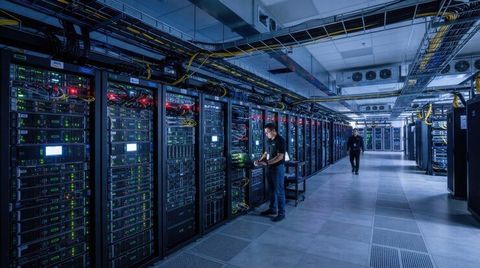
Data centres are specialised facilities that store, process, and manage large amounts of digital information. They contain computer servers, networking equipment, storage systems, cooling technology, and backup power infrastructure. These facilities support many activities people use every day, including online banking, video streaming, cloud computing, digital communication, and artificial intelligence (AI).
The growing use of AI has changed how digital information is processed. Traditional computing systems mainly handled websites, databases, business applications, and routine online activities. Modern AI systems require considerably more computing capacity because they process large datasets, recognise patterns, generate content, and respond to complex instructions.
Data centres provide the physical infrastructure needed for these activities. As organisations introduce AI into their operations, they require additional computing resources to train AI models and operate them for everyday users. This development is creating demand for new facilities, advanced processors, high-speed networks, and improved energy systems across different regions.
How Data Centres Work
A data centre operates through several connected technologies that work together to manage digital information. Its main components include:
Servers: Powerful computers that process information and run digital applications.
Storage systems: Equipment that keeps documents, databases, images, videos, and other digital records.
Networking equipment: Hardware that transfers information between servers, users, and other facilities.
Cooling systems: Technology that controls temperatures and prevents equipment from overheating.
Power infrastructure: Electrical systems, backup generators, and batteries that maintain continuous operation.
These components allow organisations to operate digital platforms without maintaining all the required physical equipment themselves. Data centres may belong to individual companies, cloud computing providers, telecommunications organisations, or specialised infrastructure operators.
Why Artificial Intelligence Requires More Computing Infrastructure
AI applications often perform calculations that require substantial processing capacity. Training a large language model, for example, involves analysing enormous quantities of information and adjusting billions of numerical parameters.
Graphics processing units (GPUs) and other specialised processors help complete these calculations. Unlike traditional processors designed for a broad range of tasks, GPUs can perform many calculations simultaneously, making them useful for AI workloads.
AI applications also require computing capacity after training. Every time an AI system generates an answer, analyses an image, or processes a voice instruction, it uses computing resources. As the number of users increases, the infrastructure required to support these activities also expands.
Importance
Why Data Centres Matter in Everyday Life
Data centres have become an important part of modern society because many daily activities depend on digital infrastructure. People may not interact directly with these facilities, but they rely on them whenever they use online banking, digital payments, navigation applications, educational platforms, or communication tools.
AI is extending this dependence into additional areas. Healthcare organisations use AI to examine medical images, manufacturers use it to monitor equipment, and educational platforms use it to support personalised learning. Each application requires computing infrastructure to process information and deliver results.
The expansion of data centres also affects several industries:
Healthcare: AI-based systems process medical images, assist with research, and organise large volumes of patient information.
Education: Digital learning platforms use AI to support language processing, content analysis, and interactive learning.
Manufacturing: Industrial organisations use computing systems for equipment monitoring, production planning, and quality inspection.
Banking: Financial institutions use data processing systems to examine transactions and identify unusual patterns.
Transportation: Navigation platforms and transport networks use computing infrastructure to analyse traffic conditions and coordinate operations.
The Growing Need for Electricity and Cooling
One of the major challenges associated with data centre expansion is electricity consumption. Servers operate continuously, and AI processors can require substantial electrical power when handling complex workloads.
Cooling is another important requirement. High-performance processors generate heat during operation, and temperature control is necessary to maintain equipment reliability. Depending on the facility, cooling may involve air circulation, liquid cooling, chilled water systems, or combinations of different technologies.
The International Energy Agency estimated that data centres consumed approximately 415 terawatt-hours (TWh) of electricity in 2024, representing around 1.5% of global electricity consumption. Its subsequent analysis identified further growth in electricity demand during 2025.
Challenges for Communities and Businesses
The growth of data centres creates several infrastructure challenges. Large facilities can place additional pressure on regional electricity networks, particularly where multiple projects are concentrated in the same area.
Other important considerations include:
Water management: Some cooling technologies require water, which can create pressure in regions experiencing water shortages.
Environmental effects: Electricity generation and equipment manufacturing can contribute to greenhouse gas emissions.
Land requirements: Large facilities need suitable locations, road connections, electrical infrastructure, and supporting buildings.
Equipment availability: Advanced processors, transformers, and electrical components may face supply limitations.
Digital security: Facilities must protect sensitive information against cyberattacks, unauthorised access, and physical disruption.
These challenges show that expanding computing infrastructure involves more than constructing additional buildings. Energy planning, environmental management, network capacity, and local development policies also play important roles.
Recent Updates
Expansion of AI-Focused Data Centres
During 2024–2026, AI became a major influence on the development of digital infrastructure. Technology organisations increased their focus on facilities designed to support large-scale AI training and inference.
Traditional data centres were generally designed around mixed computing activities, including websites, databases, business applications, and cloud platforms. New AI-focused facilities increasingly use specialised processors, high-speed connections, and advanced cooling arrangements.
The International Energy Agency reported that global data centre electricity consumption increased by 17% in 2025, while electricity use by AI-focused facilities increased by approximately 50%. Its 2026 analysis also highlighted continued investment and expansion in computing infrastructure.
Development of Advanced Cooling Technology
As AI processors become more powerful, managing heat has become an important engineering consideration. Conventional air-cooling systems remain widely used, but some high-density computing environments require additional cooling methods.
Liquid cooling is receiving increased attention because it can transfer heat directly from processors and other equipment. Direct-to-chip cooling and immersion cooling are two approaches being explored or implemented in specialised facilities.
These technologies can help manage heat in high-density computing environments. However, their suitability depends on equipment design, water availability, maintenance requirements, and the facility's operating conditions.
Greater Attention to Renewable Energy
Electricity demand has encouraged data centre operators to examine different energy sources. Solar, wind, hydropower, nuclear energy, battery storage, and conventional electricity generation all form part of discussions about future infrastructure.
Renewable electricity agreements are becoming an important part of energy planning. Some organisations are also examining battery storage and on-site generation to manage interruptions and regional grid limitations.
The International Energy Agency's 2025 analysis discussed the growing role of renewable electricity in meeting additional data centre demand, alongside natural gas and nuclear generation.
Edge Computing and Regional Infrastructure
Another development is the expansion of edge computing. Instead of processing all information in a distant central facility, edge computing places processing equipment closer to users, connected devices, and industrial operations.
This approach can reduce the distance information travels and support applications that require quick responses. Examples include industrial automation, connected vehicles, smart buildings, and real-time monitoring systems.
Regional data centres and smaller computing facilities may therefore operate alongside large AI infrastructure rather than replacing it.
Overview of Important Developments
Development | Main purpose | Potential effect |
|---|---|---|
AI-focused facilities | Handle intensive AI workloads | Greater computing capacity |
Liquid cooling | Manage processor temperatures | Improved heat management |
Renewable energy | Support electricity requirements | Lower dependence on some conventional sources |
Edge computing | Process information closer to users | Reduced communication delays |
Advanced networking | Transfer large datasets efficiently | Improved data movement |
Laws or Policies
International Regulations and Standards
Data centres operate under several regulatory frameworks because they involve electricity consumption, environmental protection, information security, construction, and data privacy.
There is no single international law governing every aspect of data centre operations. Requirements differ according to national legislation, regional regulations, and the type of information being processed.
In the European Union, the Energy Efficiency Directive establishes reporting requirements for data centres with significant energy consumption. Commission Delegated Regulation (EU) 2024/1364 introduced a common framework for reporting energy performance indicators.
The European Commission has also continued developing approaches to assess energy efficiency and environmental performance during 2025 and 2026. These measures focus on improving transparency around electricity use, water consumption, and infrastructure efficiency.
Data Protection and Cybersecurity Requirements
Data centres frequently process personal, financial, commercial, and organisational information. Their operators must therefore consider applicable privacy and cybersecurity legislation.
Important regulatory areas include:
Data protection: Rules governing how personal information is collected, stored, processed, and transferred.
Cybersecurity: Requirements for protecting digital infrastructure against unauthorised access and cyber incidents.
Environmental compliance: Regulations concerning electricity use, water management, waste disposal, and emissions.
Construction permissions: Local requirements covering land use, buildings, fire safety, and electrical installations.
India's Data Centre Policy Environment
India is developing its digital infrastructure through national digital programmes, state-level investment frameworks, electricity regulations, and data protection legislation.
The Digital Personal Data Protection Act, 2023, together with its applicable rules and implementation requirements, forms part of India's framework for handling digital personal information.
Different Indian states also use their own policy approaches to encourage data centre development. These may address land availability, electricity infrastructure, renewable energy, telecommunications connectivity, and planning permissions.
For organisations operating in India, regulatory requirements depend on the nature of their activities, the information they process, and the locations in which their facilities operate.
Tools and Resources
Several technical tools and information platforms help organisations understand data centre performance, energy requirements, and infrastructure planning.
Energy and Infrastructure Monitoring Tools
Some commonly used tools and resources include:
Data Centre Infrastructure Management (DCIM): Software platforms that monitor server equipment, electrical systems, cooling infrastructure, and facility capacity.
Power Usage Effectiveness (PUE): A measurement used to compare total facility energy consumption with the energy consumed by IT equipment.
Water Usage Effectiveness (WUE): An indicator used to understand water consumption in relation to computing equipment energy use.
Energy monitoring platforms: Systems that examine electricity consumption, equipment performance, and cooling efficiency.
Capacity planning tools: Applications that help estimate computing requirements, equipment availability, and infrastructure expansion needs.
Research and Information Platforms
The following organisations publish information relevant to data centre development:
International Energy Agency (IEA): Publishes research on electricity demand, AI infrastructure, and global energy developments.
European Commission: Provides information about energy efficiency requirements and environmental reporting frameworks.
Bureau of Energy Efficiency (BEE), India: Publishes information about energy conservation and efficiency initiatives.
Uptime Institute: Provides technical research and industry information concerning data centre infrastructure and operational reliability.
These resources help readers understand how computing infrastructure is developing and how energy, technology, and environmental considerations influence its expansion.
FAQs
1. What are data centres, and why are they important for AI?
Data centres are facilities containing servers, storage systems, and networking equipment. They provide the computing infrastructure required to train AI models, process information, and operate AI applications.
2. Why is artificial intelligence increasing global demand for data centres?
AI applications require substantial computing capacity for training and everyday processing. As AI adoption expands across industries, organisations require additional servers, specialised processors, storage capacity, and supporting infrastructure.
3. How much electricity do data centres consume?
Electricity consumption varies according to facility size, equipment, workload, and cooling technology. The International Energy Agency estimated global consumption at approximately 415 TWh in 2024, with further growth recorded in 2025.
4. How do data centres manage heat generated by AI processors?
Facilities use cooling technologies such as air circulation, chilled water systems, direct-to-chip liquid cooling, and immersion cooling. The appropriate approach depends on equipment density and infrastructure design.
5. What is the environmental impact of expanding data centres?
Expansion can increase electricity demand, water consumption, electronic waste, and greenhouse gas emissions. Energy-efficient equipment, renewable electricity, responsible water management, and improved cooling systems can help address these challenges.
Conclusion
Data centres are becoming increasingly important as artificial intelligence, cloud computing, and digital applications expand worldwide. Their development requires additional computing equipment, reliable electricity, advanced cooling systems, and secure networks. At the same time, energy consumption, environmental effects, and regulatory requirements remain important considerations. The future of digital infrastructure will depend on how technological development progresses alongside responsible energy and resource management.

Related Post...

Discover How Humanoid Robots Are Reshaping Manufacturing and Industrial Workflows
Updated: November 28, 2026
Read More
AI Agents Explained: Explore How Autonomous AI Systems Transform Business Operations
Updated: November 28, 2026
Read More
AI Killer Robots: An Overview of Global Efforts to Agree on Restrictions
Updated: November 28, 2026
Read More