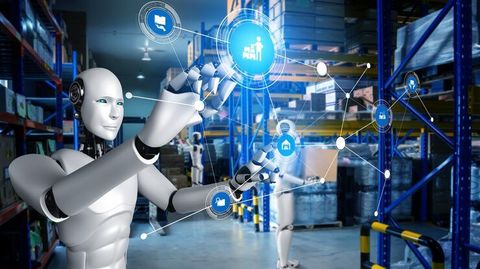
Autonomous Warehouse Robots: An Overview of Business Uses and Operational Benefits
Autonomous robots are increasingly becoming an important part of modern commercial warehouses. These machines use sensors, cameras, artificial intelligence (AI), and navigation technologies to perform physical tasks with limited direct human control. Their main purpose is to help warehouses manage inventory, move materials, organize products, and coordinate daily operations.
Commercial warehouses handle large volumes of products for manufacturers, retailers, distributors, and e-commerce businesses. As order volumes increase and supply chains become more complex, traditional warehouse operations can face challenges involving product movement, inventory accuracy, storage capacity, and delivery schedules.
Autonomous warehouse robots help address these challenges by performing repetitive activities and supporting employees with physically demanding tasks. Unlike traditional automated equipment that often follows fixed routes, many modern autonomous mobile robots (AMRs) can identify obstacles, interpret their surroundings, and adjust their movements.
These systems are available in several forms, including:
Autonomous Mobile Robots (AMRs): Navigate warehouse floors and transport products between locations.
Automated Guided Vehicles (AGVs): Follow predefined routes using markers, magnetic strips, or other guidance systems.
Robotic Picking Systems: Identify and retrieve products from storage locations.
Autonomous Forklifts: Move pallets and materials between designated warehouse areas.
Robotic Sorting Systems: Organize packages according to destination, category, or processing requirements.
Each type performs different functions, depending on warehouse size, inventory characteristics, and operational requirements.
Why Autonomous Warehouse Robots Matter Today
Warehouse operations have become more demanding because of changing consumer expectations, international trade, e-commerce growth, and increasingly complex distribution networks. Businesses must coordinate inventory movement, storage, packaging, and dispatch while maintaining accurate records.
Autonomous robots provide an additional way to manage these activities. They can operate alongside warehouse employees, helping organizations improve consistency and reduce unnecessary manual movement.
Improving Operational Efficiency
One important benefit is the ability to automate repetitive warehouse activities. Robots can transport products between storage areas, picking stations, and packing zones without requiring employees to manually move every item.
This can help reduce unnecessary walking and improve the coordination of warehouse workflows.
Supporting Inventory Management
Autonomous robots can work with warehouse management systems (WMS) to support inventory tracking and product identification. When combined with barcode scanners, RFID technology, and computer vision, they can help maintain accurate inventory records.
Potential applications include:
Locating products within storage areas.
Supporting inventory counting activities.
Identifying misplaced items.
Moving products between storage locations.
Updating warehouse movement records.
Improving Workplace Safety
Moving heavy materials and operating industrial equipment can create workplace risks. Autonomous forklifts and mobile robots can handle certain transportation activities within controlled environments.
However, robots must operate with appropriate safety systems, restricted movement zones, emergency stopping mechanisms, and employee training.
Managing Changing Order Volumes
Warehouses often experience fluctuations in demand during seasonal periods, promotional events, and major distribution cycles. Autonomous systems can help businesses adjust material movement and task allocation as operational requirements change.
Key Business Benefits and Applications
Business area | Application | Potential benefit |
|---|---|---|
Inventory management | Automated stock scanning | Better inventory visibility |
Material handling | Robotic transportation | Reduced manual movement |
Order fulfilment | Robotic picking assistance | Improved workflow coordination |
Packaging | Automated product handling | Consistent processing |
Sorting | Robotic package classification | Organized distribution |
Pallet movement | Autonomous forklifts | More structured transportation |
Recent Developments and Warehouse Robotics Trends (2025–2026)
The warehouse robotics industry is evolving through improvements in artificial intelligence, computer vision, machine learning, and autonomous navigation. Recent developments indicate a growing focus on flexible robots that can perform multiple activities rather than operating as single-purpose machines.
Artificial Intelligence and Smarter Navigation
AI is helping autonomous robots interpret warehouse environments and make navigation decisions. Modern systems can process information from cameras, sensors, and mapping technologies to identify obstacles and adjust routes.
In February 2025, the International Organization for Standardization published updated ISO 10218-1:2025 requirements for industrial robot safety. This development reflects the continuing importance of safety as industrial robotics becomes more advanced.
New Autonomous Forklift Technologies
On July 7, 2026, ABB Robotics announced its Flexley Stack F712 autonomous forklift. The system extends visual simultaneous localization and mapping (Visual SLAM) technology to autonomous pallet transportation and high-density warehouse storage.
The development also highlights the growing use of shared navigation and fleet management platforms for different types of warehouse robots.
Next-Generation Mobile Robots
In June 2026, OMRON Robotics announced its next-generation LD-150 and LD-300 autonomous mobile robots. The models were designed for heavier material transportation, improved safety features, and operation in tighter warehouse environments.
Robots Working Alongside Employees
Another important development is the introduction of more adaptable robots that can handle repetitive material transportation and container movement.
In 2026, Amazon discussed an upgraded Proteus warehouse robot that can interpret spoken instructions and coordinate transportation activities. The technology was undergoing testing, with European deployment planned for the first half of 2027.
These developments indicate several emerging trends:
Greater integration of AI with warehouse robotics.
Improved obstacle detection and autonomous navigation.
More flexible robotic picking and pallet transportation.
Better coordination between different robot models.
Increased use of collaborative robotics in warehouse environments.
Greater attention to safety, cybersecurity, and workforce training.
Laws, Regulations, and Safety Policies
Autonomous warehouse robots operate within industrial environments where employee protection, equipment reliability, and operational safety are important. Businesses must consider applicable machinery regulations, workplace safety requirements, and technical standards before introducing robotic systems.
Regulatory requirements differ between countries, so businesses operating internationally should evaluate the rules applicable to each facility.
International Safety Standards
Several international standards provide guidance for industrial and mobile robot safety.
ISO 3691-4:2023: Covers safety requirements and verification for driverless industrial trucks, including automated guided vehicles and autonomous mobile robots.
ISO 10218-1:2025: Addresses safety requirements for industrial robots.
ISO 10218-2: Covers industrial robot applications and robot cell integration.
ISO 12100: Provides general principles for machinery risk assessment and risk reduction.
These standards help manufacturers, system integrators, and warehouse operators identify hazards and establish appropriate protective measures.
European Union Regulations
The European Union has established machinery safety requirements that affect industrial automation equipment. Regulation (EU) 2023/1230 on machinery will generally apply from January 20, 2027, replacing the previous Machinery Directive framework.
Businesses should consider machinery conformity, risk assessment, technical documentation, and applicable safety requirements when introducing autonomous equipment.
United States Regulations
In the United States, the Occupational Safety and Health Administration (OSHA) establishes workplace safety requirements relevant to warehouse operations.
Important considerations include:
Machine guarding and protection from moving equipment.
Safe forklift and industrial vehicle operation.
Employee training and workplace hazard awareness.
Lockout/tagout procedures during maintenance.
Safe separation between pedestrian and robotic traffic.
India: Industrial Robotics and Workplace Safety
In India, the Occupational Safety, Health and Working Conditions Code, 2020 came into force on November 21, 2025. It provides a broader framework for workplace health, safety, and working conditions. Its provisions are relevant to establishments using industrial equipment and automated systems.
India's Machinery and Electrical Equipment Safety (Omnibus Technical Regulation) Amendment Order, 2025 also established September 1, 2026 as the implementation date for the listed machinery and electrical equipment covered by the regulation. Applicable Indian Standards must be considered when determining conformity.
Warehouse operators should assess the equipment's applicable classification and regulatory requirements rather than assuming every autonomous robot is covered by identical rules.
Tools and Resources for Autonomous Warehouse Robotics
Businesses can use several technology platforms and assessment methods to understand warehouse automation requirements and coordinate robotic operations.
Warehouse Management Systems (WMS)
A WMS organizes inventory records, storage locations, picking activities, and order processing. Integration with autonomous robots helps coordinate product movement with warehouse activities.
Examples include:
SAP Extended Warehouse Management.
Oracle Warehouse Management.
Manhattan Active Warehouse Management.
Blue Yonder Warehouse Management.
Robot Fleet Management Software
Fleet management platforms coordinate multiple robots operating within the same facility. They can assign tasks, manage routes, monitor battery levels, and help prevent traffic conflicts.
Examples include:
OMRON FLOW Core.
ABB AMR Studio.
LocusONE.
MiR Fleet.
Warehouse Planning and Simulation Tools
Simulation tools help businesses examine warehouse layouts and evaluate automation scenarios before making operational changes.
Useful technologies include:
Digital twin platforms for warehouse modelling.
Robotics simulation software for testing navigation.
CAD tools for warehouse layout planning.
Inventory analytics dashboards for identifying movement patterns.
Useful Evaluation Resources
Resource | Main purpose |
|---|---|
ISO standards | Robot and machinery safety guidance |
OSHA resources | Workplace safety information |
BIS standards | Indian industrial safety standards |
WMS platforms | Inventory and warehouse coordination |
Robotics simulation | Testing robotic movement |
Fleet management software | Coordinating multiple robots |
These resources can help businesses evaluate technical requirements, workplace risks, system compatibility, and operational performance.
Frequently Asked Questions
1. What are autonomous robots in commercial warehouses?
Autonomous warehouse robots are machines that use sensors, AI, cameras, and navigation software to perform warehouse activities with limited human intervention. They can transport products, move pallets, support inventory management, and assist with order fulfilment.
2. How do autonomous mobile robots improve warehouse operations?
Autonomous mobile robots help transport products between warehouse locations, reduce unnecessary employee movement, and coordinate material handling. They can also adjust routes when obstacles are detected, depending on their navigation capabilities.
3. Can autonomous robots work alongside human employees?
Yes. Many warehouse robots are designed to operate in shared environments with employees. Safety sensors, emergency stopping systems, designated movement zones, and appropriate training help reduce workplace risks.
4. What technologies are used in autonomous warehouse robots?
Common technologies include:
Artificial intelligence and machine learning.
LiDAR sensors and computer vision.
Radio-frequency identification (RFID).
Simultaneous localization and mapping (SLAM).
Wireless communication systems.
Warehouse management software.
These technologies help robots understand their surroundings, identify objects, navigate routes, and coordinate activities.
5. What should businesses consider before implementing warehouse robotics?
Businesses should evaluate warehouse layout, inventory volume, operational requirements, employee training, equipment compatibility, cybersecurity, and workplace safety. They should also examine integration with existing warehouse management systems and establish measurable performance indicators before implementation.
Conclusion
Autonomous robots are becoming an important component of modern commercial warehouse operations. Through AI, machine vision, autonomous navigation, and robotic material handling, these technologies help businesses organize inventory, coordinate product movement, and manage increasingly complex logistics activities.
Their applications extend across manufacturing warehouses, retail distribution centres, e-commerce fulfilment facilities, and international supply chains. Different robotic systems support specific activities, including pallet transportation, inventory tracking, sorting, and product picking.
However, successful implementation requires more than introducing robotic equipment. Businesses must consider operational planning, employee training, equipment integration, cybersecurity, and applicable safety regulations.
As robotics technology continues to develop, autonomous systems are expected to play a growing role in connected warehouse environments. Combining human expertise with intelligent automation can help organizations build more organized, adaptable, and efficient warehouse operations.

Related Post...
Commercial HVAC Innovations: Insights Into Smart Controls and Energy Management
Updated: November 26, 2026
Read More
Discover How Smart Technologies Are Transforming Commercial Refrigeration
Updated: November 26, 2026
Read More
Key Insights Into Global Industrial Equipment Demand From Data Centre Growth
Updated: November 26, 2026
Read More