Industrial 3D Printers: A Complete Guide to Modern Manufacturing
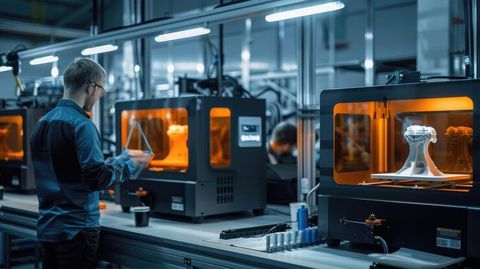
Industrial 3D printers are advanced manufacturing machines that create physical objects directly from digital designs. Unlike traditional manufacturing methods, which often involve cutting, drilling, moulding, or shaping solid materials, industrial 3D printing builds objects layer by layer. This process is commonly known as additive manufacturing.
These machines are designed for professional manufacturing environments where precision, material performance, repeatability, and production quality are important. They can produce prototypes, machine components, automotive parts, aerospace structures, medical devices, industrial tools, and specialised equipment.
Industrial additive manufacturing uses several technologies, including Fused Deposition Modeling (FDM), Selective Laser Sintering (SLS), Selective Laser Melting (SLM), Direct Metal Laser Sintering (DMLS), and Stereolithography (SLA).
Each technology works differently and supports particular materials and applications. For example, polymer-based systems are commonly used for lightweight components and functional prototypes, while metal 3D printers can manufacture complex engineering components using materials such as titanium, stainless steel, and aluminium alloys.
The development of industrial 3D printing has created new possibilities for manufacturers. It allows engineers to explore complex geometries, reduce the number of individual components in certain assemblies, and develop specialised products that may be difficult to manufacture through conventional methods.
Importance of Industrial 3D Printing in Modern Manufacturing
Industrial 3D printing has become an important part of modern manufacturing because industries increasingly require flexible production methods, specialised components, and advanced material capabilities.
Traditional manufacturing processes can involve multiple stages, specialised moulds, and extensive material removal. Additive manufacturing provides an alternative approach that builds components directly from digital models.
Applications Across Major Industries
Several industries use industrial 3D printers for product development, component manufacturing, and technical research.
Aerospace: Produces lightweight aircraft components, turbine parts, brackets, and complex structural components.
Automotive: Supports prototype development, specialised vehicle components, production fixtures, and lightweight parts.
Healthcare: Enables the development of customised implants, surgical models, dental components, and anatomical models.
Industrial Manufacturing: Creates machine components, replacement parts, specialised tools, and manufacturing equipment.
Energy: Supports the development of turbine components, heat exchangers, and specialised equipment.
Architecture and Construction: Enables the production of architectural models, structural prototypes, and selected concrete components.
Key Advantages of Industrial 3D Printers
Industrial additive manufacturing provides several technical advantages.
Design flexibility: Engineers can create complicated shapes, internal channels, lattice structures, and geometries that are difficult to produce using conventional methods.
Material efficiency: Certain additive processes use only the material needed to construct a component, although supports and unused powder may still require additional handling.
Rapid prototyping: Product development teams can produce physical models and evaluate design changes without creating conventional production moulds.
Customised production: Manufacturers can create components with different dimensions or configurations based on specific technical requirements.
Digital production: Digital design files support repeatable workflows and can help manufacturers organise production across different facilities.
Industrial 3D Printing Compared With Traditional Manufacturing
Manufacturing factor | Industrial 3D printing | Traditional manufacturing |
|---|---|---|
Production method | Layer-by-layer construction | Cutting, moulding, casting, or forming |
Design flexibility | High for complex geometries | Depends on equipment and tooling |
Material usage | Often more targeted | May generate additional material waste |
Customisation | Suitable for specialised designs | May require tooling changes |
Prototyping | Supports rapid design evaluation | Can involve multiple production stages |
Production volume | Suitable for selected low-to-medium volumes and specialised applications | Often effective for large production volumes |
Component structure | Can combine multiple features into one part | May require separate components |
The appropriate method depends on production volume, material requirements, component geometry, quality standards, and manufacturing specifications.
Recent Updates and Developments in Industrial 3D Printing (2025–2026)
Industrial additive manufacturing has continued to develop through improvements in printing technologies, material performance, production software, and manufacturing standards.
Advancements in Industrial Printer Technology
On April 14, 2026, HP announced developments across its additive manufacturing portfolio at RAPID + TCT 2026. These included the introduction of the Multi Jet Fusion 1200 system, improvements to the Jet Fusion 5600 series, and additional material capabilities for industrial applications.
The company also announced a high-productivity printing mode for the Jet Fusion 5600 series, with a reported 20% improvement in productivity. These developments reflect the industry's focus on production efficiency and broader industrial adoption.
Improvements in Material Science
Material development is expanding the range of industrial 3D printing applications.
In March 2026, researchers at Savannah River National Laboratory and partner institutions introduced research involving a technology called CRAFT. The approach uses light to adjust material properties, including strength, flexibility, and durability during the printing process.
This research demonstrates the potential for more controlled material characteristics in additive manufacturing.
Development of Manufacturing Standards
Standardisation remains important as manufacturers increasingly use 3D-printed components in regulated industries.
On April 29, 2026, America Makes and the American National Standards Institute (ANSI) published an updated progress report covering 35 of the 141 identified standardisation gaps in additive manufacturing.
The report examines areas such as material qualification, process control, component testing, post-processing, and manufacturing data.
Expansion of Industrial Applications
The 2026 Wohlers Report estimated that global additive manufacturing revenues reached approximately $24.2 billion in 2025, representing 10.9% annual growth.
The report also highlighted increasing attention to the utilisation of existing manufacturing capacity, materials, software, and production workflows.
These developments indicate that industrial 3D printing is gradually moving beyond experimental prototyping towards more established manufacturing applications.
Laws, Regulations, and Government Policies Affecting Industrial 3D Printing
Industrial 3D printing is influenced by manufacturing regulations, workplace safety requirements, environmental rules, intellectual property protections, and product quality standards. The applicable requirements depend on the country, industry, materials, and intended application.
International Manufacturing Standards
Several international standards help manufacturers establish consistent processes and evaluate the quality of 3D-printed components.
Important organisations and standards include:
ISO/ASTM 52900: Provides fundamental terminology and definitions for additive manufacturing.
ISO/ASTM 52901: Addresses requirements for purchased additive manufacturing parts.
ISO/ASTM 52920: Covers qualification principles for industrial additive manufacturing processes and production sites.
ASTM International: Develops technical standards covering materials, testing, equipment, and manufacturing processes.
ISO 9001: Provides a quality management framework relevant to manufacturing organisations.
These standards help establish consistent manufacturing practices, although their application may depend on industry requirements and contractual obligations.
European Union Regulations
Manufacturers operating in the European Union must consider applicable machinery safety, product safety, workplace protection, and environmental legislation.
The EU Machinery Regulation (EU) 2023/1230 establishes safety requirements for machinery and will generally apply from January 20, 2027.
The EU Artificial Intelligence Act also becomes relevant when AI-based systems are integrated into manufacturing equipment or production workflows. Its implementation follows different timelines depending on the system and application.
United States Regulations
In the United States, industrial 3D printing is influenced by workplace safety requirements, product-specific regulations, and technical standards.
The Occupational Safety and Health Administration (OSHA) establishes workplace safety requirements relevant to industrial environments.
The National Institute of Standards and Technology (NIST) also conducts research into additive manufacturing measurements, process reliability, and manufacturing technologies.
Medical 3D-printed devices may additionally fall under relevant Food and Drug Administration (FDA) regulatory requirements.
Government Initiatives in India
India has introduced the National Strategy on Additive Manufacturing (NSAM), released by the Ministry of Electronics and Information Technology in February 2022.
The strategy aims to strengthen India's additive manufacturing ecosystem through research, education, industrial development, and collaboration between government, academic institutions, and manufacturers.
It also sets a target of capturing 5% of the global additive manufacturing market and contributing approximately US$1 billion to India's GDP.
Manufacturers in India must also consider applicable machinery safety requirements, electrical equipment regulations, environmental legislation, and relevant Bureau of Indian Standards (BIS) requirements.
Tools and Resources for Industrial 3D Printing
Selecting suitable industrial 3D printing software, equipment, and material evaluation tools is important for maintaining manufacturing accuracy and production quality.
Industrial 3D Printing Software
The following software platforms support different stages of the additive manufacturing workflow.
Autodesk Fusion: Supports 3D modelling, engineering design, simulation, and manufacturing preparation.
Materialise Magics: Provides build preparation, part orientation, support generation, and additive manufacturing workflow management.
nTop: Supports advanced engineering design, lattice structures, and complex geometries.
Siemens NX: Provides integrated CAD, engineering simulation, and additive manufacturing capabilities.
GrabCAD Print: Supports print preparation and manufacturing workflows for compatible industrial 3D printers.
Design and File Preparation Tools
Digital design files must be prepared carefully before they enter the printing process.
Common file formats include:
STL: Widely used for representing three-dimensional geometry.
3MF: Supports additional information, including materials and production-related data.
STEP: Used for exchanging engineering design information.
OBJ: Supports 3D geometry and surface-related information.
Material Selection Resources
Material selection depends on the component's intended function and operating environment.
Material | Important characteristics | Common applications |
|---|---|---|
Stainless steel | Strength and corrosion resistance | Industrial machinery |
Titanium alloys | High strength-to-weight ratio | Aerospace and medical |
Aluminium alloys | Lightweight and thermal conductivity | Automotive and aerospace |
Nylon PA12 | Durability and flexibility | Functional components |
PEEK | High-temperature performance | Engineering and medical applications |
Photopolymer resin | Fine surface detail | Prototypes and specialised models |
Manufacturers should evaluate mechanical strength, thermal resistance, chemical compatibility, surface quality, and material certification before selecting a printing material.
Testing and Quality Evaluation
Industrial components may require several inspection procedures, depending on their intended application.
Useful evaluation methods include:
Dimensional inspection and coordinate measuring machines (CMM).
X-ray computed tomography for internal defect examination.
Tensile testing for mechanical strength.
Surface roughness measurement.
Non-destructive testing for selected metal components.
Thermal analysis for evaluating material behaviour.
These methods help determine whether printed components meet the required engineering specifications.
Frequently Asked Questions About Industrial 3D Printers
1. What is an industrial 3D printer?
An industrial 3D printer is a professional manufacturing machine that creates physical components from digital designs using additive manufacturing technology. It is designed for applications requiring controlled production processes, specialised materials, and consistent component quality.
2. Which materials are commonly used in industrial 3D printing?
Common materials include stainless steel, titanium alloys, aluminium alloys, nylon, PEEK, engineering plastics, and specialised photopolymer resins. The selection depends on the printing technology, mechanical requirements, temperature conditions, and intended application.
3. What is the difference between industrial and desktop 3D printers?
Industrial 3D printers are generally designed for more demanding manufacturing environments, larger production workflows, specialised materials, and controlled operating conditions. Desktop printers are typically used for educational activities, personal projects, and basic prototyping.
4. Which industries benefit most from industrial additive manufacturing?
Aerospace, automotive, healthcare, energy, industrial engineering, and construction are among the industries using additive manufacturing. These sectors use the technology for prototypes, customised components, specialised equipment, and selected production applications.
5. Are industrial 3D-printed components suitable for large-scale manufacturing?
Yes, certain industrial 3D printing technologies can support repeated production and specialised manufacturing at scale. However, suitability depends on printing speed, material availability, component requirements, post-processing capacity, inspection procedures, and production volume.
Conclusion
Industrial 3D printers are changing how manufacturers approach product development, engineering design, and specialised component production. By combining digital models, advanced materials, and layer-by-layer manufacturing, these systems provide new possibilities for producing complex and customised components.
Recent developments in printer productivity, material science, process automation, and international standardisation are helping expand industrial applications. At the same time, manufacturers must consider equipment safety, material qualification, quality management, and relevant national regulations.
As additive manufacturing continues to mature, industrial 3D printing is expected to remain an important technology in aerospace, automotive, healthcare, energy, and advanced manufacturing. Understanding its technologies, materials, applications, and regulatory requirements can help organisations make informed decisions about integrating it into their production processes.

Related Post...
A Complete Guide to Plastic Recycling Machines and Their Working Processes
Updated: November 03, 2026
Read More
Digital Printing Machines Guide: Technology, Uses, and Industry Trends
Updated: November 03, 2026
Read More
Sofa Frame Stapling Machines: Key Insights into Technology and Operations
Updated: November 02, 2026
Read More